Blog
What Admin Tasks Should UK Limited Company Directors Stop Doing Themselves?
Magnolia Roy | 02 August 2026
A practical UK guide for limited company directors on which admin tasks to stop doing themselves, what to keep oversight of, and when outsourced support makes sense.

What Admin Tasks Should UK Limited Company Directors Stop Doing Themselves?
Many UK limited company directors start out doing everything themselves. Invoicing, expenses, payroll, VAT records, filing reminders, supplier payments, and month-end chasing all land on one desk.
At first, that can feel efficient. You stay in control and keep costs down.
Then the business grows. More clients, more suppliers, more employees, more filings. Admin expands faster than revenue, and the director becomes the bottleneck for work that does not need their judgment every day.
This guide explains limited company director responsibilities, which admin tasks directors should stop doing themselves, and what to keep oversight of even when support is outsourced.
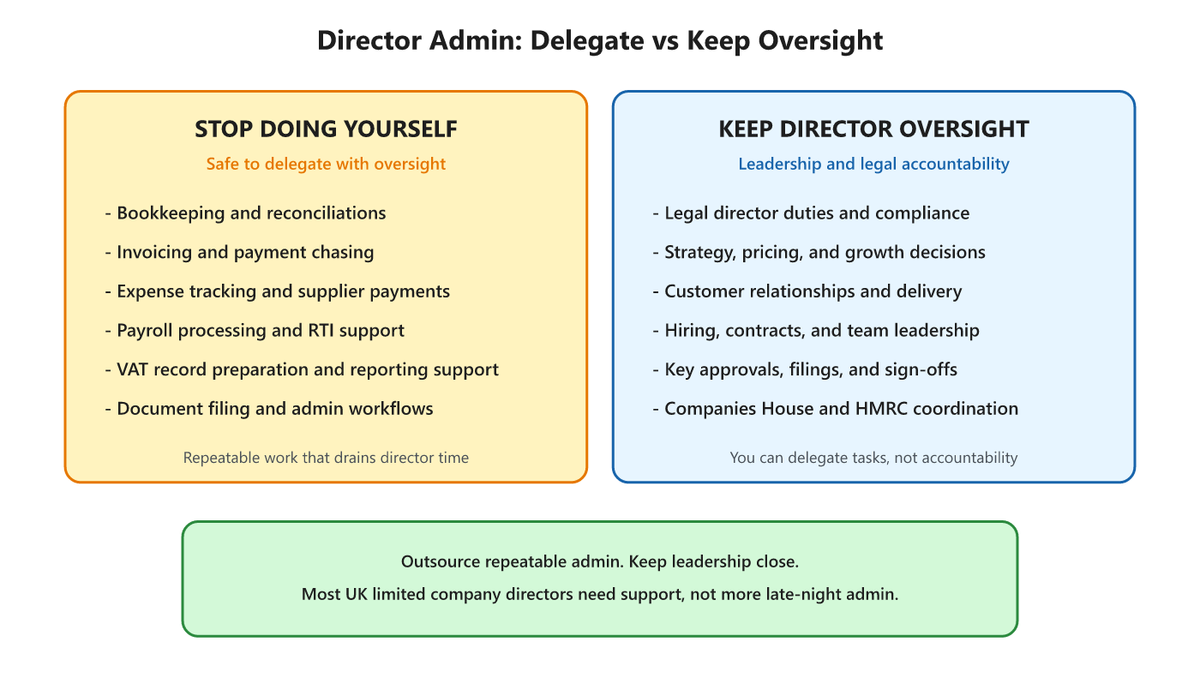
Quick answer: Directors remain legally accountable for company compliance, records, and filings, but they do not need to process every invoice, pay run, or reconciliation personally. Most growing UK limited companies should delegate repeatable admin such as bookkeeping, invoicing, expense tracking, payroll processing, VAT record preparation, and document workflows, while keeping oversight of strategy, key approvals, customer relationships, hiring, and statutory obligations.
What Directors Remain Responsible For
Being a director is not the same as being the person who codes every transaction. But some responsibilities stay with you even when tasks are outsourced.
GOV.UK guidance on running a limited company makes clear that directors must follow the company rules, keep company records, and file accounts and returns on time.
Core director responsibilities include:
- acting in the company's best interests
- keeping proper accounting records
- filing confirmation statements and annual accounts
- meeting tax and PAYE obligations
- making sure the business can pay its debts
- maintaining accurate Companies House information
You can delegate work, but you cannot delegate accountability. That is why the question is not whether to do all admin yourself, but which tasks need your time and which need reliable support behind you.
Directors also need to stay on top of Companies House identity verification and filing obligations. Our Companies House ID verification guide explains what to prepare before your next filing.
Admin Tasks Directors Should Stop Doing Themselves
These are the tasks that most growing limited companies should move off the director's desk first. They are important, but they are usually repeatable, time-heavy, and better handled through process and support.
Bookkeeping and bank reconciliations
Recording transactions, matching bank lines, and keeping the books current is essential. It does not usually need the director's judgment on every line.
GOV.UK guidance on company accounting records requires limited companies to keep records that explain transactions and show the company's financial position. That does not mean the director must do all the data entry.
If records have fallen behind, see bookkeeping cleanup vs ongoing bookkeeping.
Invoicing and payment chasing
Raising invoices, following up on late payers, and keeping cash collection moving are classic admin drains. Directors should care about cash flow. They do not need to send every reminder email.
Expense tracking and supplier payments
Processing receipts, approving routine supplier payments, and keeping purchase records tidy is another area where directors often lose hours each month.
Payroll processing
Once you employ staff, payroll becomes a compliance task with its own rhythm: payslips, PAYE, pensions, and RTI reporting. Directors remain responsible for employer obligations, but pay runs are rarely the best use of founder time.
See payroll vs accounting if you are unsure how payroll fits with wider finance support.
VAT record preparation and reporting support
VAT-registered companies need reliable records and timely reporting support. Directors should understand VAT cash impact and review returns before submission where appropriate, but record preparation can usually be handled by finance support.
Where VAT applies, businesses must also meet GOV.UK VAT record-keeping requirements.
Document filing, inbox admin, and reporting prep
Filing contracts, chasing documents, preparing packs for accountants, and keeping admin workflows moving often sits outside a director's highest-value work.
For a wider view of DIY overload, see the hidden costs of DIY back-office admin.
What Directors Should Keep Oversight Of
Outsourcing admin does not mean switching off. Directors should usually stay close to:
- strategy, pricing, and commercial decisions
- customer relationships and service standards
- hiring, leadership, and key HR decisions
- approval of unusual payments or contracts
- review of monthly numbers and cash position
- coordination of statutory filings and adviser relationships
This lines up with the wider front office vs back office split: protect growth-facing work in-house, strengthen repeatable back-office support behind the scenes.
Delegate vs Keep Oversight at a Glance
Area | Stop doing yourself | Keep director oversight |
Bookkeeping | Day-to-day coding and reconciliations | Review monthly position and major anomalies |
Invoicing and collections | Routine invoice issue and chasing | Pricing, key accounts, and escalation |
Payroll | Pay run processing and RTI support | Headcount decisions and liability awareness |
VAT | Record preparation and reporting support | Cash planning and review before submission |
Compliance admin | Document prep and workflow chasing | Filing accountability and adviser coordination |
Best outcome | More time for growth | Control without doing every task personally |
A useful rule: delegate the process, keep the judgment.
Example: A Growing Limited Company Director
A director running a ten-person marketing agency may still review management accounts and approve major hires, but stop processing every supplier invoice, running payroll, and chasing expenses herself.
Support handles bookkeeping, invoicing, payroll, VAT records, and filing prep. The director reviews monthly numbers, signs off key decisions, and stays accountable for Companies House and HMRC obligations.
That is not abdication. It is a clearer operating model.
What Directors Should Approve, Not Process
Directors do not need to process every routine task, but they should still approve the right things. That may include unusual supplier payments, payroll changes, VAT returns before submission, major customer credit decisions, and any filing where director confirmation is required. The goal is to remove manual admin while keeping the director involved at key control points.
When UK Directors Should Outsource Admin
Consider outsourced support when:
- month-end admin regularly slips into evenings or weekends
- invoices, expenses, or payroll errors are becoming more frequent
- you cannot see cash position or profit clearly each month
- compliance tasks feel reactive rather than controlled
- growth plans are delayed because the director is buried in admin
You do not need to outsource everything at once. Many limited companies start with bookkeeping or administration support, then add payroll or accounting as complexity grows.
If you are unsure how admin, bookkeeping, and accounting differ, see bookkeeping vs accounting vs admin support.
Common Mistakes When Directors Try to Do Everything
Treating delegation as losing control
Good support should make numbers clearer and deadlines more visible, not less.
Outsourcing with no review rhythm
Agree monthly check-ins, reporting, and who owns escalations.
Keeping low-value admin because it feels safer
Familiarity is not the same as efficiency. Director time has a real opportunity cost.
Splitting tasks across too many informal helpers
A bookkeeper here, a payroll contact there, and a spouse chasing invoices creates gaps. Coordinated support is usually cleaner.
Waiting until records are badly behind
Cleanup is fixable, but it costs more than staying current. See bookkeeping cleanup vs ongoing bookkeeping.
Frequently Asked Questions
What are a limited company director's responsibilities in the UK?
Directors must run the company lawfully, keep proper records, file accounts and confirmation statements, meet tax and PAYE obligations, and act in the company's best interests. See GOV.UK guidance on running a limited company.
What admin tasks can company directors outsource?
Directors can usually outsource bookkeeping, invoicing, expense processing, payroll processing, VAT record preparation, document filing, and wider admin workflows, while keeping oversight of strategy, approvals, and compliance.
Can directors delegate everything?
No. Directors can delegate tasks, but legal accountability remains with them. Oversight, key decisions, and filing responsibility still need director attention.
When should a UK director stop doing admin themselves?
Consider support when admin regularly delays growth work, records slip, errors increase, or you cannot see cash and profit clearly each month.
Is outsourced admin only for large companies?
No. Many small and mid-sized UK limited companies outsource admin early because founder time is better spent on sales, delivery, and leadership.
What is the first step if admin is overwhelming?
List the tasks consuming the most time each month, then decide which are repeatable enough to delegate first. Contact AMS for a free consultation and a practical support plan.
Disclaimer
This article is for general information only. It is not legal, tax, or financial advice. Director duties, GOV.UK guidance, and filing requirements can change. Speak to a qualified accountant, adviser, or solicitor for advice tailored to your company.
Final Thoughts
UK limited company directors carry real legal responsibilities, but they do not need to be the person running every admin process by hand.
The strongest approach is usually simple: stop doing repeatable admin yourself, keep oversight of the decisions and compliance that matter, and build support around the business as it grows.
If you want to hand over admin without losing visibility, AMS Admin Services can help. Book a free consultation and find out which tasks you should delegate first.