Blog
Understanding the Difference Between Bookkeeping Cleanup and Ongoing Bookkeeping
Magnolia Roy | 21 July 2026
A practical UK guide explaining bookkeeping cleanup versus ongoing bookkeeping, what each involves, when catch-up work is needed, and how to keep records current.
Understanding the Difference Between Bookkeeping Cleanup and Ongoing Bookkeeping
Many UK small business owners discover they need bookkeeping help only when something goes wrong. VAT is due and the records do not reconcile. The accountant asks for missing bank statements. A director cannot explain last quarter's cash position without rebuilding a spreadsheet.
At that point, the business usually needs bookkeeping cleanup, not just a standard monthly bookkeeping package.
Cleanup and ongoing bookkeeping are related, but they are not the same job. When the two are confused, businesses can end up with the wrong quote, the same backlog returning, and avoidable compliance pressure.
This guide explains what catch-up bookkeeping involves, how it differs from ongoing bookkeeping, and how UK SMEs can move from messy past records to a steady monthly rhythm.
What Is Bookkeeping Cleanup?
Bookkeeping cleanup (sometimes called catch-up bookkeeping) is project-style work to bring historical records up to date and fit for use.
It is needed when transactions were recorded inconsistently, bank accounts were not reconciled, or months of paperwork were never posted properly.
Typical bookkeeping cleanup tasks include:
- reviewing past sales, purchases, and expenses
- locating missing invoices, receipts, and bank statements
- reconciling bank, card, and payment processor accounts
- correcting miscoded or duplicate transactions
- aligning records with VAT periods already filed or due
- bringing the ledger current to an agreed cut-off date
Cleanup is about fixing the past so the business has a reliable starting point. It is usually more intensive than routine monthly bookkeeping because the provider must reconstruct what happened, not simply maintain what is already in order.
If DIY admin has been slipping for a while, see our guide on the hidden costs of DIY back-office admin for why backlog work often costs more than prevention.
What Is Ongoing Bookkeeping?
Ongoing bookkeeping is the regular monthly discipline of keeping records current after the backlog is cleared.
Typical ongoing bookkeeping tasks include:
- recording transactions as they happen or on a fixed monthly cycle
- reconciling bank and card accounts on schedule
- maintaining supplier and customer ledgers
- preparing data for VAT, payroll, and management reporting
- flagging missing documents before deadlines arrive
- keeping the books ready for your accountant or tax adviser
Ongoing bookkeeping is preventive. The goal is to stop the backlog returning and to give directors clearer numbers throughout the year.
If you are unsure how bookkeeping fits with accounting and admin support, see bookkeeping vs accounting.
Bookkeeping Cleanup vs Ongoing Bookkeeping
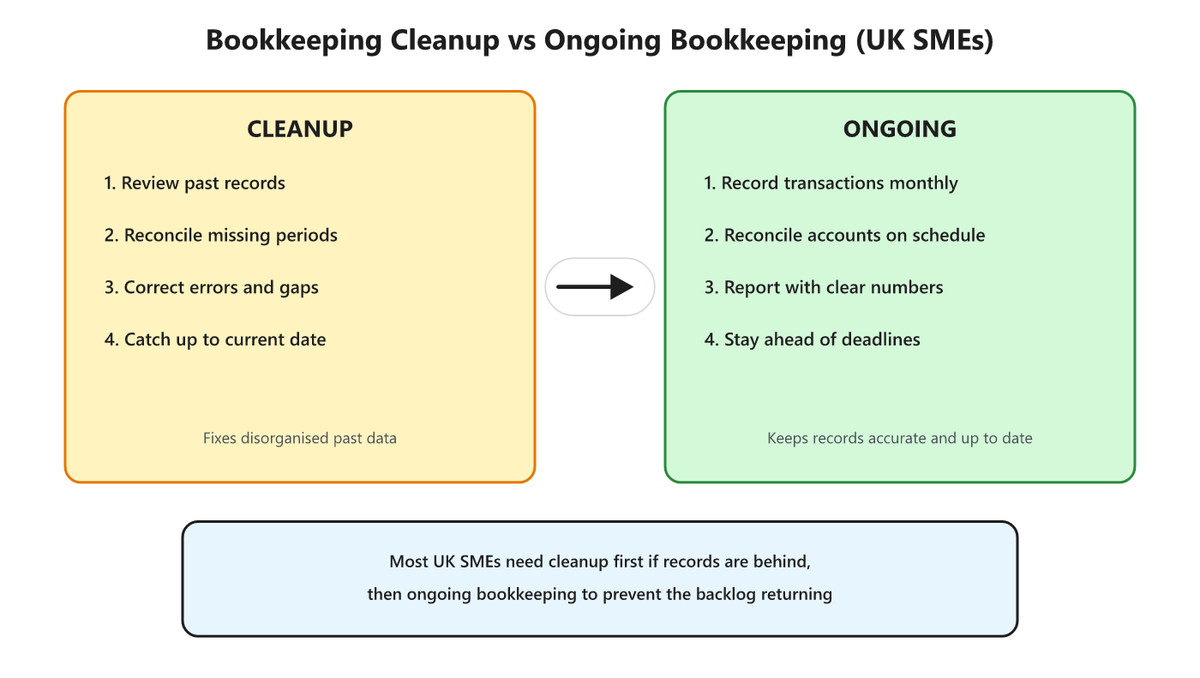
Factor | Bookkeeping cleanup | Ongoing bookkeeping |
Purpose | Fix historical records and catch up | Keep records current month to month |
Timing | Project-based, often urgent | Recurring monthly rhythm |
Scope | Past periods with gaps or errors | Current transactions and reconciliations |
Intensity | Higher upfront effort | Steady, predictable workload |
Typical trigger | Backlog, accountant request, VAT pressure | Business wants reliable monthly records |
Outcome | Clean starting point | Accurate, up-to-date books |
A useful rule: cleanup solves the past; ongoing bookkeeping protects the future.
Why UK SME Records Fall Behind
Bookkeeping backlogs rarely happen because owners ignore finance deliberately. More often, the business outgrows informal habits.
Common causes include:
- founder-led DIY bookkeeping during rapid growth
- staff changes with no clear handover
- new VAT, payroll, or software setup without process discipline
- mixing personal and business transactions
- delayed document collection from suppliers or staff
- accountant requests arriving only at year-end
HMRC guidance on keeping records makes clear that businesses need reliable records to support tax reporting. Limited companies normally need to keep accounting records for six years, and self-employed businesses must keep tax records for at least five years after the relevant Self Assessment deadline.
Poor records do not only create admin stress. They can also make VAT returns, payroll checks, and year-end accounts harder and more expensive to complete.
When You Need Bookkeeping Cleanup
Consider cleanup if several of these apply:
- you are more than one to two months behind on reconciliations
- your accountant says records are not ready for VAT or year-end work
- bank balances in software do not match actual statements
- you cannot produce a clear profit view for a recent month
- VAT returns were filed with estimates or unresolved gaps
- you changed bookkeepers or software and the handover was messy
- you are switching from spreadsheets to cloud accounting
Cleanup is often the right first step before outsourcing ongoing support. Starting monthly bookkeeping on top of a backlog usually means the provider is still fixing old problems while trying to keep up with new transactions.
When Ongoing Bookkeeping Is Enough
Ongoing bookkeeping alone is usually enough when:
- records are broadly current
- bank accounts reconcile regularly
- documents are collected on a predictable cycle
- your accountant receives usable data each period
- you want better monthly visibility, not emergency catch-up
If records are only slightly behind, a short catch-up phase may still be needed before a normal monthly package begins. The key is agreeing the cut-off date and scope in writing.
What a Sensible Cleanup-to-Ongoing Process Looks Like
A practical UK SME workflow often follows four stages.
1. Scope the backlog
Agree which periods need review, which bank accounts are in scope, and what "caught up" means. This prevents open-ended cleanup work.
2. Collect missing documents
Gather bank statements, invoices, receipts, payroll summaries, VAT workings, and any prior accountant adjustments.
3. Complete cleanup and review
The provider reconciles accounts, corrects errors, and confirms the books are current to the agreed date.
4. Move to ongoing bookkeeping
Once the backlog is cleared, switch to a monthly rhythm: record, reconcile, report, and stay ahead of deadlines.
Skipping step four is how backlogs return. Cleanup without ongoing discipline often leads to the same problem six months later.
How Cleanup and Ongoing Bookkeeping Affect Costs
Fees vary by backlog size, transaction volume, number of bank accounts, VAT complexity, and how disorganised the source documents are.
Cleanup is often priced as a one-off project or hourly scope because the workload is harder to predict. Ongoing bookkeeping is usually priced monthly once the records are stable.
When comparing quotes, use the same approach as our accountant prices UK guide: compare deliverables, not just the lowest monthly fee.
Questions to ask any provider:
- what periods are included in cleanup?
- what documents must you supply?
- when will the books be current?
- what happens after cleanup ends?
- what is included in ongoing monthly bookkeeping?
- how will VAT, payroll, and year-end handovers work?
AMS provides personalised quotes after a free consultation rather than one-size pricing for every backlog.
How AMS Admin Services Helps UK SMEs
AMS Admin Services helps UK SMEs move from messy records to reliable monthly bookkeeping.
Through our accounting and financial management services from £349/mo, we support:
- bookkeeping, VAT record preparation, and VAT return support where included in scope
- catch-up and cleanup work where needed
- bank reconciliations and ledger maintenance
- management account preparation
- cashflow management and KPI reporting
Where wider admin tasks are also slipping, our administration services from £249/mo can support invoicing, accounts payable and receivable, and document workflows alongside the books.
Book a free consultation and we will review how far behind your records are, whether cleanup is needed first, and what monthly bookkeeping rhythm will keep the backlog from returning.
Common Mistakes With Bookkeeping Cleanup
Treating cleanup as ordinary monthly bookkeeping
A heavy backlog needs scoped project work. A standard monthly fee may not cover it.
Starting ongoing support before agreeing the cut-off date
Without a clear "caught up to" date, cleanup can drift and costs can rise.
Not supplying documents promptly
Cleanup speed depends on access to bank statements, invoices, and payroll records. Delays on the client side delay the finish date.
Skipping ongoing support after cleanup
Cleanup fixes the past. Ongoing bookkeeping stops the backlog returning.
Assuming cleanup replaces accounting or tax advice
Cleanup improves records. VAT filing, statutory accounts, and tax planning may still sit with your accountant or adviser.
Frequently Asked Questions
What is bookkeeping cleanup?
Bookkeeping cleanup is catch-up work to review, reconcile, and correct past records so the business has accurate books up to an agreed date.
What is the difference between cleanup and ongoing bookkeeping?
Cleanup fixes historical backlogs. Ongoing bookkeeping keeps records current month to month after the backlog is cleared.
How do I know if I need catch-up bookkeeping?
You likely need catch-up work if reconciliations are months behind, your accountant cannot use your records, or bank balances do not match your software.
Can I do bookkeeping cleanup myself?
Some owners start DIY cleanup, but backlogs often involve reconciliation errors, VAT mismatches, and missing documents that take longer to fix without experience. Many SMEs outsource cleanup to move faster and reduce compliance risk.
How long does bookkeeping cleanup take?
It depends on how many periods are behind, how many accounts you have, and how complete your documents are. A scoped review after seeing the records is more reliable than a generic estimate.
Is ongoing bookkeeping the same as accounting?
No. Ongoing bookkeeping maintains records and reconciliations. Accounting usually includes compliance, reporting, and tax work built on those records. Most growing UK businesses need both layers.
How much does catch-up bookkeeping cost in the UK?
Costs vary by backlog size and complexity. AMS provides personalised quotes after reviewing your records and scope requirements.
What is the first step if my books are behind?
Gather recent bank statements and list how many months need review. Contact AMS for a free consultation and we will recommend cleanup, ongoing support, or a combined approach.
Disclaimer
This article is for general information only. It is not tax, legal, or financial advice. HMRC rules, GOV.UK guidance, and filing requirements can change. Speak to a qualified accountant or adviser for advice tailored to your business.
Final Thoughts
Bookkeeping cleanup and ongoing bookkeeping solve different problems. Cleanup repairs the past. Ongoing work protects the future.
If your records are behind, do not assume a standard monthly package will quietly fix months of backlog. Scope the catch-up work first, agree the cut-off date, then move into a steady monthly rhythm.
That is how UK SMEs get clearer numbers, less deadline stress, and books that stay useful all year, not only at year-end.
If you want help with catch-up bookkeeping and ongoing support under one roof, AMS Admin Services can help. Book a free consultation and find out whether cleanup, ongoing bookkeeping, or both fit your business today.