Blog
Bookkeeping vs Accounting vs Admin Support: What UK Business Owners Actually Need
Magnolia Roy | 24 July 2026
A practical UK guide explaining the difference between bookkeeping, accounting, and admin support, and how to choose the right mix for your small business.
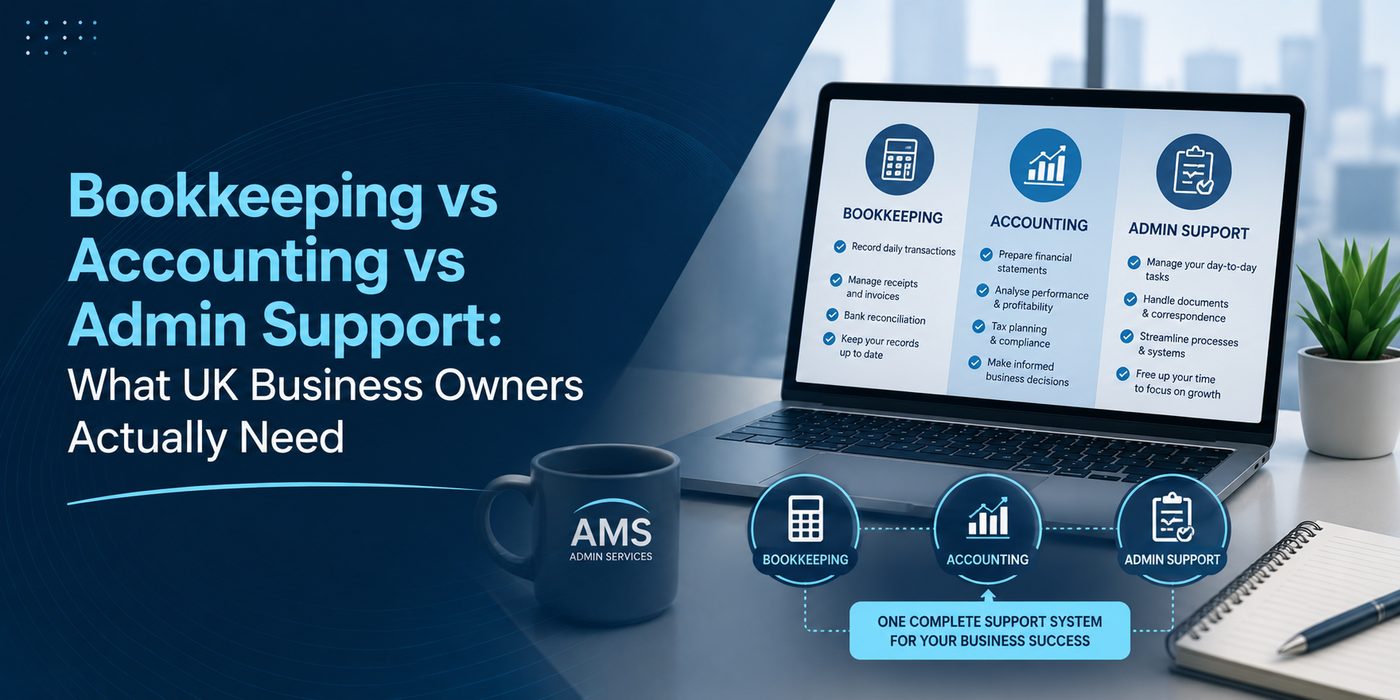
Bookkeeping vs Accounting vs Admin Support: What UK Business Owners Actually Need
If you search for bookkeeping vs accounting, you will find plenty of definitions. Few explain where admin support fits, or what a UK small business owner actually needs at each stage of growth.
The terms overlap in everyday conversation. An accountant may do bookkeeping. A bookkeeper may chase unpaid invoices. An admin support provider may process supplier payments. That overlap is why owners overpay for the wrong package, duplicate work, or leave gaps that cause compliance problems later.
This guide explains what each service covers, how they differ, and how UK business owners can build the right mix of support without paying for more than they need.
Why UK Business Owners Get Confused
Three things blur the lines:
- Job titles vary. Some firms call the same work "bookkeeping", "accounts preparation", or "admin support".
- Software has changed roles. Cloud accounting tools let owners record transactions themselves, while accountants focus more on reporting and advice.
- Growing businesses need all three layers. Records, compliance, and day-to-day back-office tasks do not stop when you hire your first bookkeeper or accountant.
The useful question is not "bookkeeper vs accountant" in isolation. It is: what work must get done, who is best placed to do it, and what can you stop doing yourself?
What Is Bookkeeping?
Bookkeeping is the day-to-day recording and organising of financial transactions. It creates the raw data your business runs on.
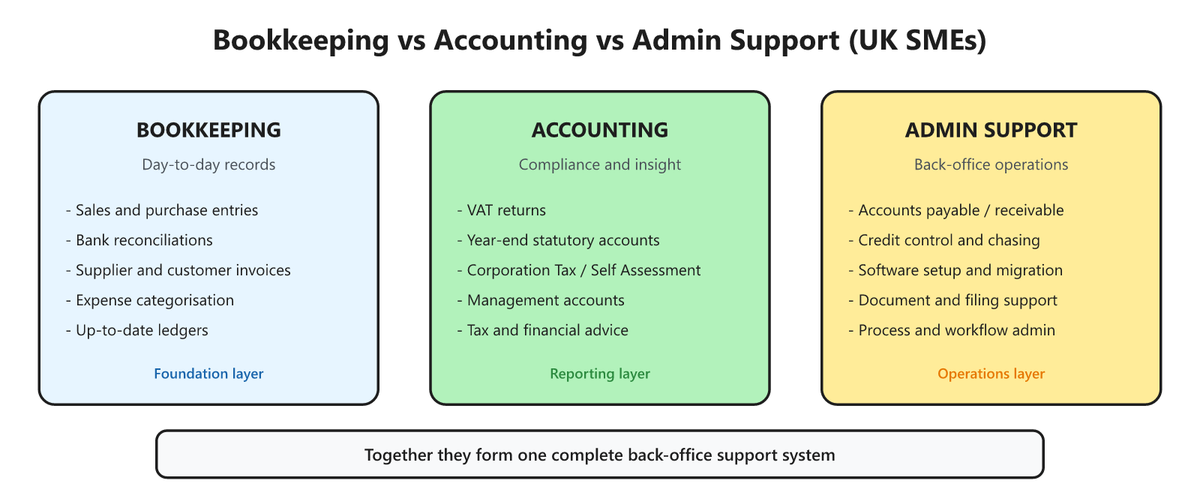
Typical bookkeeping tasks include:
- recording sales and purchases
- reconciling bank and card accounts
- processing supplier and customer invoices
- categorising expenses
- keeping ledgers up to date in accounting software
GOV.UK guidance for sole traders states that when you start trading you must keep records to work out your profit or loss for your Self Assessment tax return. Good bookkeeping makes that possible.
Bookkeeping is the foundation. Without accurate, timely records, VAT returns, year-end accounts, and management reporting all become harder and more expensive.
What Is Accounting?
Accounting builds on bookkeeping to produce reports, meet legal obligations, and support decisions. It is broader and usually requires professional training and qualifications.
Typical accounting work includes:
- preparing VAT returns
- preparing statutory year-end accounts
- filing accounts with Companies House and tax returns with HMRC
- Corporation Tax and Self Assessment support
- management accounts and financial analysis
- tax planning and business advice
Limited companies must prepare statutory annual accounts from the company's financial records and file them with Companies House and HMRC. GOV.UK sets out filing deadlines for accounts and Company Tax Returns.
Accounting is the reporting and compliance layer. It turns bookkeeping data into formal outputs and insight.
What Is Admin Support?
Admin support covers the operational back-office tasks that keep a business running smoothly but are not always described as "accounting".
Typical admin support includes:
- accounts payable processing (paying suppliers on time)
- accounts receivable support (chasing customer payments)
- credit control and debt management
- accounting software setup and migration
- document organisation and filing workflows
- routine financial administration and process support
This is where many UK SMEs feel the strain. Owners know they need help, but the work does not always fit neatly into "bookkeeping" or "accounting". Chasing overdue invoices, setting up a new cloud system, or managing supplier payment runs is often admin support.
For growing businesses, admin support is the operations layer that stops back-office work from piling up on the founder's desk.
Bookkeeping vs Accounting vs Admin Support: Quick Comparison
Area | Bookkeeping | Accounting | Admin support |
Main focus | Recording transactions | Compliance and financial reporting | Running back-office processes |
Typical output | Up-to-date books | Accounts, tax returns, management reports | Paid bills, chased debts, organised workflows |
Who often does it | Bookkeeper, admin team, or owner | Qualified accountant or accountancy firm | Admin specialist or outsourced support team |
How often | Weekly or monthly | Monthly, quarterly, and year-end | Ongoing as tasks arise |
Depends on | Source documents and bank feeds | Accurate bookkeeping records | Clear processes and systems |
Risk if neglected | Messy records, missed deadlines | Penalties, incorrect tax, poor decisions | Cash flow pressure, supplier issues, wasted time |
How the Three Layers Work Together
Think of your back office as a stack:
- Bookkeeping captures what happened financially.
- Accounting interprets it for compliance and strategy.
- Admin support keeps the operational machine moving between those steps.
If bookkeeping slips, accounting costs rise because someone must fix records before returns can be filed. If admin support is missing, even good bookkeeping can leave you with unpaid bills, late customer payments, and constant firefighting.
Many UK SMEs need all three, but not always at the same volume. A sole trader with simple income may need bookkeeping help and annual accounting support. A limited company with staff, VAT, and 200 monthly transactions may need ongoing bookkeeping, regular accounting, and dedicated admin support.
What UK Business Owners Typically Need by Business Stage
Stage | Bookkeeping | Accounting | Admin support |
New sole trader, few transactions | Basic record keeping (often DIY with software) | Annual Self Assessment support | Minimal |
VAT-registered or hiring first staff | Regular bookkeeping | VAT, payroll reporting, tax compliance | Payment processing, document support |
Growing limited company | Ongoing bookkeeping | Statutory accounts, management reporting | Credit control, AP/AR, software support |
Multi-site or fast growth | Dedicated bookkeeping | Full accounting and advisory | Strong admin and process support |
This is a guide, not a rigid rule. Your sector, transaction volume, and how much time you spend on admin will shift the balance.
Bookkeeper vs Accountant: Do You Need Both?
Not always as two separate people, but you usually need both types of work done properly.
A bookkeeper (or bookkeeping service) keeps records current. An accountant reviews those records, handles compliance, and advises on tax and structure. Some accountancy firms provide both under one monthly fee. Others charge separately for catch-up bookkeeping if records are behind.
Signs you need bookkeeping support:
- you are months behind on reconciliations
- you dread updating your software
- your accountant quotes extra for "tidying up" every year
Signs you need accounting support:
- you are VAT registered or run a limited company
- you are unsure about tax deadlines or allowable expenses
- you want management accounts or growth planning
Signs you need admin support:
- supplier payments and invoice chasing eat your week
- you are migrating accounting software or setting up new processes
- you want someone to own routine back-office tasks, not just year-end compliance
Sole Trader vs Limited Company: Service Expectations
Factor | Sole trader | Limited company |
Core records | Income and expense records for Self Assessment | Full company books and statutory accounts |
Typical compliance | Self Assessment, possible VAT | Companies House filings, Corporation Tax, possible VAT and PAYE |
Bookkeeping depth | Often simpler | Usually more detailed |
Admin support need | Grows with volume and complexity | Often higher from the start |
GOV.UK notes that sole traders must keep records when they start trading. Limited companies face additional filing requirements under GOV.UK company accounts guidance.
DIY, Software, or Outsource?
Many owners start by doing their own bookkeeping in cloud software. That can work early on. It becomes harder when:
- transaction volume increases
- VAT or payroll adds monthly deadlines
- you need reliable data for decisions, not just year-end survival
GOV.UK guidance on choosing a tax agent explains that you can appoint someone to deal with HMRC on your behalf if you want professional help. The same principle applies to wider accounting and admin support: outsource when the cost of your time and the risk of errors outweigh the fee.
When comparing providers, check what is included. A low bookkeeping quote may exclude VAT. A bookkeeping package may not include credit control. An accounting fee may assume your records are already clean. See our guide to accountant prices in the UK for how to compare quotes fairly.
How AMS Admin Services Brings the Three Together
AMS Admin Services is built around the idea that UK SMEs need more than year-end accounts. They need a back office that works every week.
We combine:
- Administration services from £249/mo for accounts management, accounts payable and receivable, software migration, and system setup
- Accounting and financial management from £349/mo for bookkeeping, VAT, statutory accounts, management reporting, and cashflow support
That means you can get bookkeeping, accounting, and admin support from one team rather than juggling three separate providers who do not talk to each other.
Our approach:
- Free consultation to understand your business and quote clearly
- Matched support from professionals suited to your needs
- Regular check-ins so problems are spotted before deadline season
If you are unsure which layer you need first, we will help you prioritise. Many clients start with bookkeeping and admin support, then add deeper accounting and reporting as they grow.
Common Mistakes When Choosing Support
Hiring an accountant for work that is really admin
Paying qualified accounting rates for invoice chasing or data entry is expensive. Match the task to the right service level.
Hiring a bookkeeper but skipping accounting compliance
Clean books do not replace VAT returns, statutory accounts, or tax advice. You still need the compliance layer.
Assuming one generic package fits every business
Compare what is included. Two "monthly accounting" quotes can cover very different work.
Waiting until year-end to fix record problems
Catch-up work costs more than ongoing support. If your records slip every quarter, monthly help usually saves money.
Ignoring admin until cash flow suffers
Late payments from customers and missed supplier deadlines are often admin problems, not accounting problems.
Frequently Asked Questions
What is the difference between bookkeeping and accounting?
Bookkeeping records day-to-day transactions. Accounting uses those records to prepare reports, meet legal filing requirements, and support tax and business decisions.
Do I need a bookkeeper or an accountant?
Most growing UK businesses need both types of work. You may get both from one firm. Simple sole traders sometimes need only light bookkeeping support and annual tax help.
What is admin support for a small business?
Admin support covers operational back-office tasks such as processing payments, chasing debts, organising documents, and supporting accounting software and workflows.
Can one provider do bookkeeping, accounting, and admin support?
Yes. Many outsourced providers, including AMS, offer combined services so your records, compliance, and routine admin stay aligned.
Is bookkeeping enough for a limited company?
Usually no. Limited companies must meet statutory accounts and tax filing requirements described on GOV.UK. Bookkeeping feeds those obligations but does not replace them.
When should a UK SME outsource back-office support?
Consider outsourcing when you are behind on records, approaching VAT or payroll registration, spending too much time on admin, or facing cash flow issues linked to late payments and poor processes.
How much does bookkeeping and accounting support cost in the UK?
Fees vary by business size and scope. AMS publishes starting points on our service pages, with personalised quotes after a free consultation. See our UK accountant prices guide for what affects fees.
How does AMS help UK business owners choose the right support?
AMS offers administration, bookkeeping, VAT, payroll, and accounting services under one roof. Book a free consultation and we will recommend support matched to your business stage.
Final Thoughts
Bookkeeping vs accounting is only part of the picture. UK business owners also need to think about admin support: the everyday back-office work that keeps cash moving, suppliers paid, and systems running.
The right mix depends on your structure, transaction volume, and how much time you lose to tasks that someone else could handle better. Start with honest answers about what is slipping today, then build support in layers rather than buying a generic package you do not understand.
If you want one team for bookkeeping, accounting, and admin support, AMS Admin Services can help. Contact us for a free consultation and a clear quote built around what your business actually needs.