Blog
Do I Need an Accountant for Making Tax Digital? A Practical Guide for UK SMEs
Magnolia Roy | 12 August 2026
A practical UK guide to whether you need an accountant for Making Tax Digital for Income Tax, what changes in 2026, and how to decide between DIY and professional support.
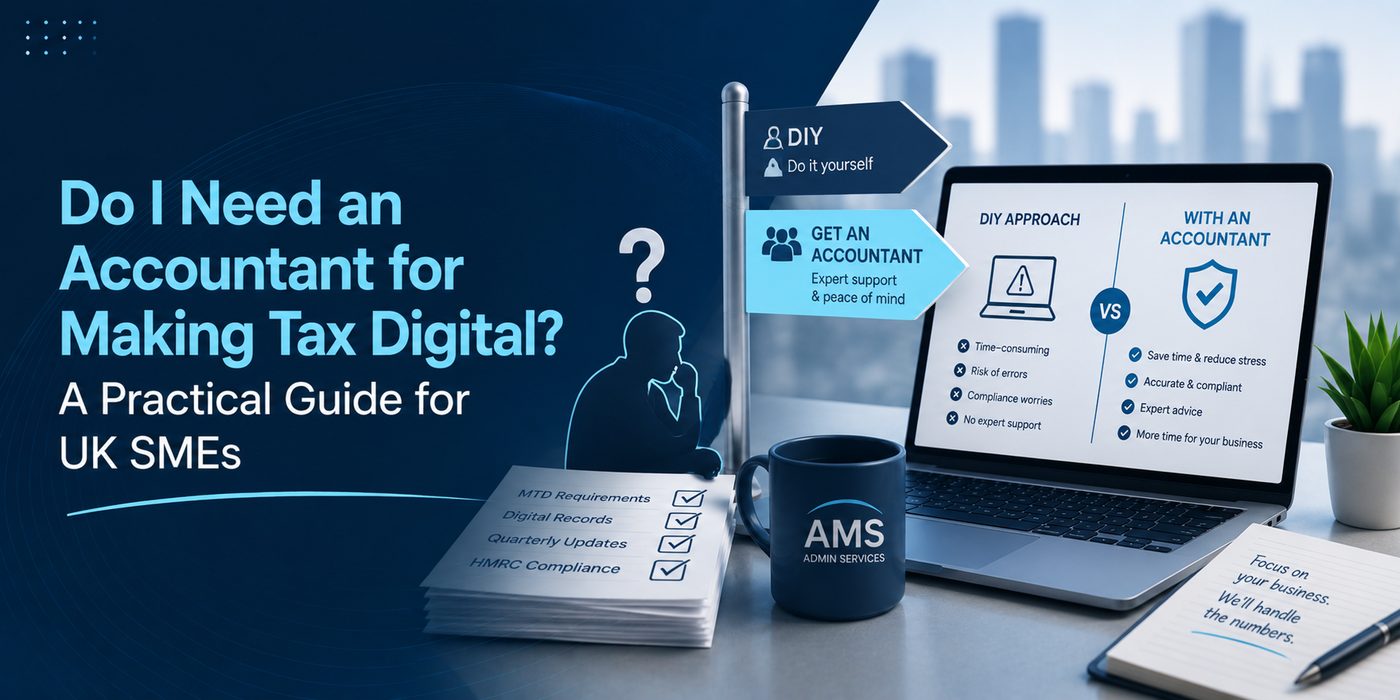
Do I Need an Accountant for Making Tax Digital? A Practical Guide for UK SMEs
If you run a UK small business, you have probably seen headlines about Making Tax Digital (MTD) and wondered whether you can manage it yourself or need an accountant.
The honest answer is: it depends on which MTD rules apply to you, how complex your income is, and how confident you are with digital records and quarterly reporting.
This guide focuses on Making Tax Digital for Income Tax, which affects many sole traders and landlords from April 2026. It explains what changes, when you might manage it yourself, and when professional support is worth paying for.
What Is Making Tax Digital for Income Tax?
Making Tax Digital for Income Tax is a new way for sole traders and landlords to report self-employment and property income to HMRC.
GOV.UK guidance explains that you, or your agent if you have one, will need to use software compatible with Making Tax Digital for Income Tax to:
- create, store, and correct digital records of self-employment and property income and expenses
- send quarterly updates to HMRC
- submit your tax return by 31 January the following year
Some parts of Self Assessment stay the same. You still submit one tax return each year and pay your tax bill by the usual deadline. What is new is digital record-keeping and quarterly updates during the year.
This is different from Making Tax Digital for VAT, which already applies to VAT-registered businesses above the VAT threshold. This blog focuses on Income Tax changes for sole traders and landlords. Limited companies file Corporation Tax and company accounts separately, though they may still need MTD for VAT if registered.
Who Must Use MTD for Income Tax?
You will need to use Making Tax Digital for Income Tax if all of the following apply:
- you are a sole trader or landlord registered for Self Assessment
- you get income from self-employment or property, or both
- your qualifying income is above the relevant threshold for the tax year
GOV.UK defines when you must start based on qualifying income in a tax year:
Self Assessment tax year | Qualifying income threshold | Start using MTD for Income Tax from |
2024 to 2025 | More than £50,000 | 6 April 2026 |
2025 to 2026 | More than £30,000 | 6 April 2027 |
2026 to 2027 | More than £20,000 | 6 April 2028 |
Qualifying income is your total turnover from self-employment and property income before expenses, based on the tax return you submitted in the previous tax year. GOV.UK explains this in more detail.
You do not need to start until after you have submitted your first Self Assessment tax return. HMRC may write to you if your income is above the threshold, but GOV.UK states it is still your responsibility to check if and when you need to use the service.
Use the GOV.UK tool to check if you need Making Tax Digital for Income Tax and when you need to start.
What Changes Under MTD for Income Tax?
If you are in scope, your routine tax work changes in three main ways.
1. Digital records
You must create and store digital records of self-employment and property income and expenses using compatible software. GOV.UK notes that if you use spreadsheets, you may need bridging software to submit updates.
2. Quarterly updates
You must send quarterly updates every three months during the tax year for each sole trader business and property business you have. These are summaries of income and expenses, not full tax returns.
For businesses starting MTD from April 2026, GOV.UK sets out key dates including:
Task | Deadline (from April 2026 start) |
Create digital records | From 6 April 2026 (standard update periods) or 1 April 2026 (calendar update periods) |
First quarterly update | By 7 August 2026 |
Second quarterly update | By 7 November 2026 |
Third quarterly update | By 7 February 2027 |
Fourth quarterly update | By 7 May 2027 |
Submit tax return and pay tax due | By 31 January 2028 |
3. Software-led tax return
You submit your end-of-year tax return through compatible software, check other income sources, claim reliefs, and pay tax as you do now.
Penalty rules are also changing. GOV.UK explains the new points-based system for late quarterly updates and returns.
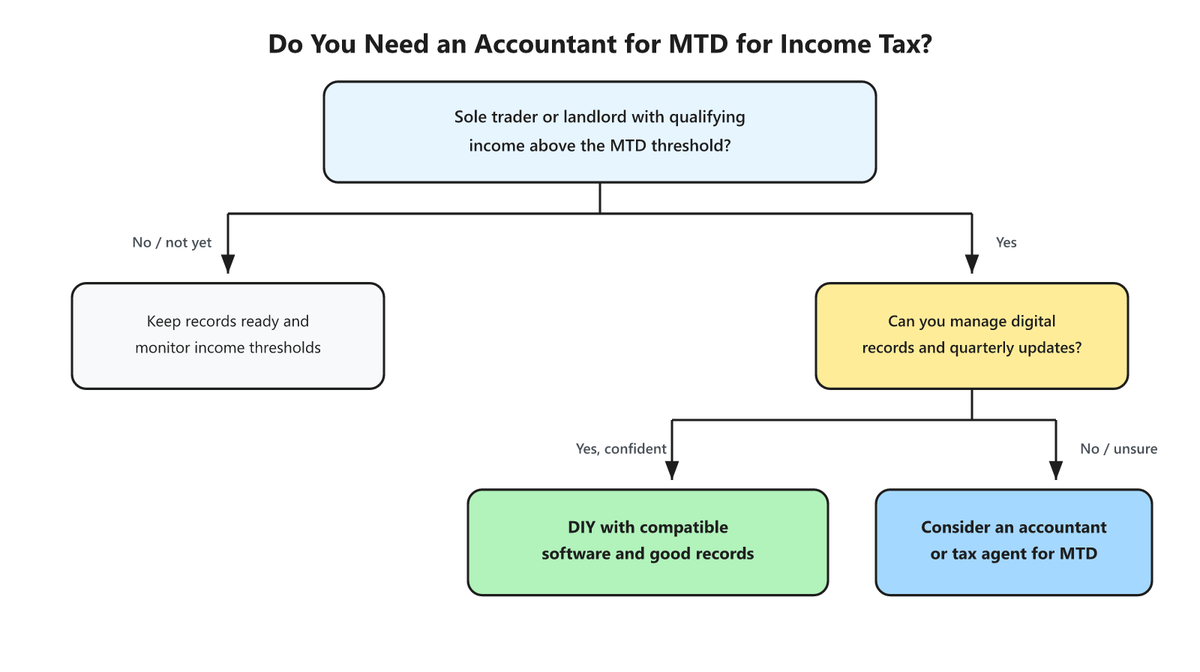
Do I Need an Accountant for MTD? The Short Answer
You are not legally required to hire an accountant for Making Tax Digital. HMRC does not mandate professional representation.
But many sole traders and landlords will find that an accountant or tax agent saves time, reduces errors, and helps them meet quarterly deadlines without disrupting their business.
Whether you need one depends on:
- how many income sources you have
- whether you are confident choosing and using MTD-compatible software
- how organised your current records are
- whether you already miss Self Assessment deadlines
- if you have property and self-employment income together
- whether you want someone to deal with HMRC on your behalf
GOV.UK guidance on getting tax help states that an accountant or tax adviser may be able to help with your tax, and you will need to authorise them to deal with HMRC for you.
When You Might Manage MTD Yourself
DIY can work if your situation is straightforward.
Factor | DIY may be realistic if... |
Income sources | You have one simple sole trade or one rental property |
Records | You already keep tidy digital records weekly or monthly |
Software | You are comfortable choosing MTD-compatible software |
Time | You can commit to quarterly updates without last-minute panic |
Tax history | You usually file Self Assessment on time with few adjustments |
If you already use cloud accounting software and reconcile your accounts regularly, MTD may feel like a natural extension rather than a complete overhaul.
GOV.UK step-by-step guidance walks through signing up, choosing software, and sending updates if you take the DIY route.
When an Accountant Is Worth It for MTD
Professional support often pays off when complexity increases.
Situation | Why an accountant helps |
Multiple income streams | Property plus self-employment, foreign income, or other Self Assessment sources |
Messy or paper-based records | Someone must rebuild digital records before quarterly updates work |
No time for quarterly deadlines | An agent can manage updates and remind you what is due |
First year in scope | You want setup support for software, categories, and HMRC authorisation |
Previous late filings | New penalty rules make missed quarterly updates more costly over time |
Growth plans | You need tax advice beyond compliance, not just data entry |
An accountant does not replace your responsibility to keep the business running, but they can own the MTD process: software setup, digital records, quarterly submissions, and the final return.
If you are unsure what support level you need, our guide to bookkeeping vs accounting vs admin support explains how the layers fit together.
What an Accountant Does for MTD (vs What You Still Do)
Task | You (business owner) | Accountant / tax agent |
Run the business and keep receipts | Yes | No |
Choose whether to appoint an agent | Yes | Advises |
Authorise agent in HMRC services | Yes | Receives authorisation |
Set up MTD-compatible software | Can do DIY | Often handles setup |
Create and maintain digital records | Can do DIY | Often handles ongoing |
Send quarterly updates | Can do DIY | Submits on your behalf |
Review figures and ask questions | Yes | Explains and advises |
Submit year-end tax return | Can do DIY | Prepares and files |
Pay tax bill | Yes | Reminds and advises |
You remain legally responsible for the accuracy of your tax affairs even when an agent acts for you. A good accountant makes that responsibility easier to meet, not optional.
MTD for Income Tax vs MTD for VAT: Do Not Mix Them Up
MTD for Income Tax | MTD for VAT | |
Who it affects | Sole traders and landlords in scope | VAT-registered businesses |
Main change | Quarterly income/expense updates + digital records | Digital VAT records and VAT return submission |
Accountant question | "Do I need help with Self Assessment MTD?" | "Is my VAT process MTD-compliant?" |
A VAT-registered sole trader may need support for both. A limited company director is not in MTD for Income Tax scope in the same way, but the company may need VAT MTD and statutory accounts support.
If you are comparing overall support costs, see our UK accountant prices guide.
How to Prepare Before April 2026
Whether you DIY or hire help, preparation should start before your mandatory start date.
- Check if you are in scope using the GOV.UK MTD for Income Tax checker.
- Work out your qualifying income from your latest Self Assessment return.
- Review exemptions if you think you may be digitally excluded or qualify for an exemption.
- Choose compatible software or ask your accountant to recommend one. GOV.UK notes HMRC does not provide software.
- Sign up for Making Tax Digital for Income Tax before you need to use it.
- Authorise your agent if you are using an accountant. GOV.UK explains that you must authorise an accountant or tax adviser to deal with HMRC for you.
If you are an agent's client, they will need the correct authorisations in their Agent Services Account before they can act for you on MTD.
Common Mistakes When Deciding on MTD Support
Waiting until the first quarterly deadline
Software setup, record migration, and agent authorisation take time. April 2026 will arrive quickly if records are still in a shoebox.
Assuming last year's accountant package covers MTD
Ask explicitly whether quarterly MTD updates are included in your fee or billed separately.
Choosing software that cannot do everything you need
GOV.UK warns that your software must handle digital records, quarterly updates, and the final return, including other income sources.
Ignoring MTD because you are below the threshold today
Income can cross £50,000, £30,000, or £20,000 in a strong year. Monitor qualifying income even if you are not in scope yet.
Confusing MTD with general bookkeeping
MTD requires compatible software and quarterly submissions. Tidy spreadsheets alone are not enough unless bridging software connects them to HMRC.
How AMS Admin Services Can Help
AMS Admin Services supports UK small businesses with practical accounting and back-office help as tax rules go digital.
We can help with:
- bookkeeping and digital records through our accounting and financial management services
- ongoing admin support so you spend less time on paperwork via administration services
- compliance support for Self Assessment, VAT, and wider obligations through our compliance services
We explain what is included before work starts, match you with suitable support, and help you get records ready so MTD is manageable rather than stressful.
If you are unsure whether you need full accounting support or lighter bookkeeping help, book a free consultation and we will recommend a sensible starting point.
Frequently Asked Questions
Is it compulsory to use an accountant for Making Tax Digital?
No. MTD for Income Tax requires compatible software and digital reporting. You can do this yourself or use an authorised tax agent. GOV.UK explains how to appoint an accountant or tax adviser if you want professional help.
Who must use Making Tax Digital for Income Tax from April 2026?
Sole traders and landlords registered for Self Assessment whose qualifying income was over £50,000 in the 2024 to 2025 tax year must start from 6 April 2026. Lower thresholds apply from April 2027 and April 2028. See GOV.UK guidance.
What is qualifying income for MTD?
It is your total turnover from self-employment and property income before expenses, based on your previous tax return. GOV.UK explains how this is worked out.
Can I use spreadsheets for MTD?
You may keep records in spreadsheets, but you will need compatible software or bridging software to send quarterly updates and submit your tax return. GOV.UK explains this requirement.
How often do I send updates under MTD for Income Tax?
You send quarterly updates every three months during the tax year for each relevant business. You still submit one tax return annually by 31 January.
Do limited companies need MTD for Income Tax?
MTD for Income Tax applies to sole traders and landlords in scope. Limited companies have separate Corporation Tax and accounts filing rules. VAT-registered companies must comply with MTD for VAT where applicable.
What should I ask an accountant before signing up for MTD support?
Ask whether they are authorised as your tax agent, which software they use, whether quarterly updates are included, how they will migrate your existing records, and what happens if you miss a deadline.
How can AMS help with Making Tax Digital?
AMS provides bookkeeping, accounting, compliance, and admin support for UK SMEs. We help you get digital records in order and stay on top of ongoing reporting. Contact us for a free consultation.
Final Thoughts
Do you need an accountant for Making Tax Digital? Not always. But if you are in scope for MTD for Income Tax from April 2026 and your records, software, or time are already stretched, professional support is often the lower-risk choice.
The best time to decide is before your first quarterly deadline, not the week it is due. Check your position on GOV.UK, get your records digital-ready, and choose a path you can sustain all year.
If you want plain-English help preparing for MTD without surprise fees, AMS Admin Services is here to support you. Book a free consultation and find out what level of help fits your business.