Blog
Front Office vs Back Office: What UK Business Owners Should Keep In-House
Magnolia Roy | 10 August 2026
A practical UK guide to front office vs back office work, what business owners should usually keep in-house, and which back-office tasks are often better outsourced.
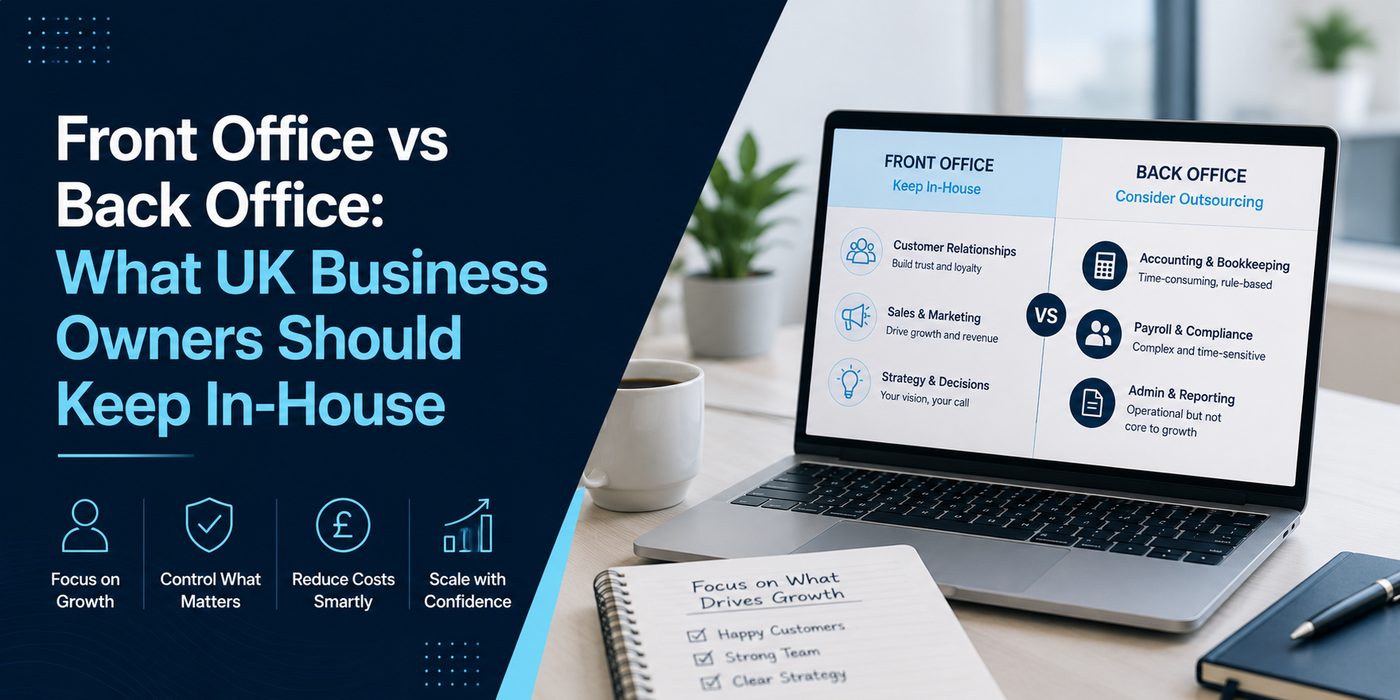
Front Office vs Back Office: What UK Business Owners Should Keep In-House
Many UK business owners know they are busy. Fewer stop to ask which work actually needs to stay with them.
Front office work is what customers see: sales conversations, service delivery, and the decisions that shape how the business grows.
Back office work keeps the business running behind the scenes: bookkeeping, payroll, invoicing, compliance, and reporting.
When founders spend too much time on back-office tasks, growth slows. When they outsource the wrong front-office work, customer relationships suffer.
This guide explains front office vs back office, what UK business owners should usually keep in-house, and which back-office functions are often better outsourced.
What Is Front Office Work?
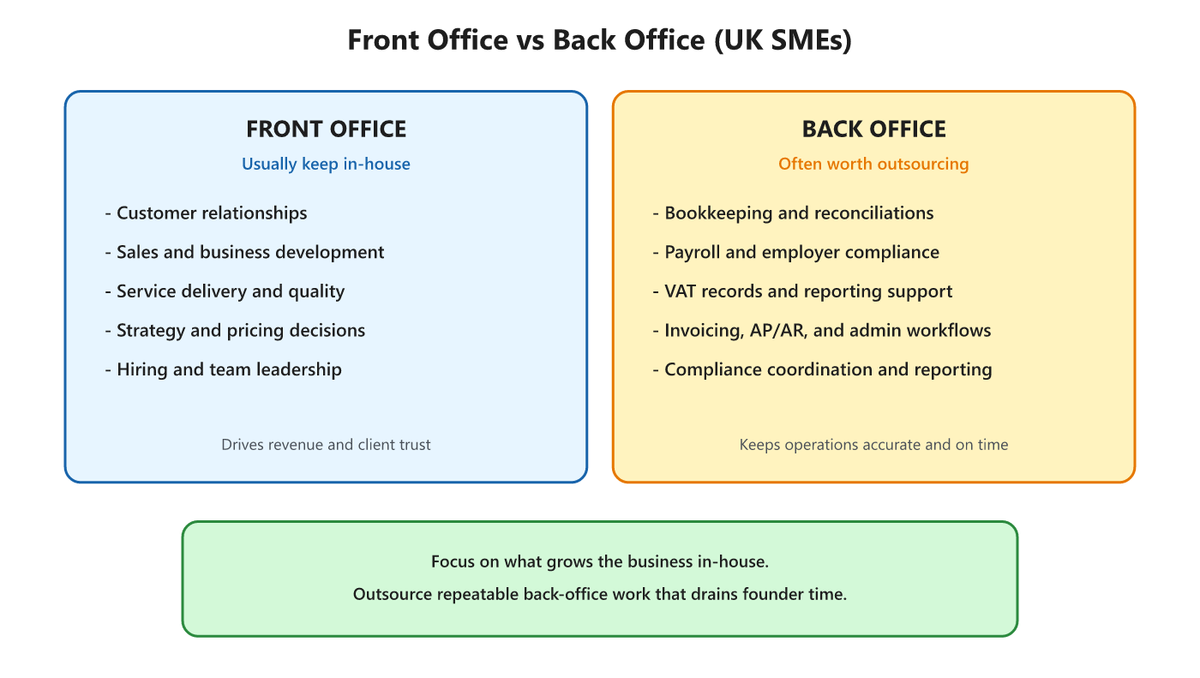
Front office work is customer-facing and revenue-focused. It is where trust, sales, and service quality are built.
Typical front office functions include:
- sales and business development
- customer service and account management
- marketing and brand positioning
- product or service delivery
- pricing and commercial decisions
- hiring and leading customer-facing teams
For most UK SMEs, this is where the founder or core team adds the most value. Clients may not choose you because your VAT records are tidy, but they will feel the impact if poor admin leads to delays, errors, or weaker service.
What Is Back Office Work?
Back office work supports the business internally. Customers may never see it directly, but they feel the impact when it slips.
Typical back office functions include:
- bookkeeping and reconciliations
- invoicing, payment chasing, and supplier payments
- payroll processing and employer compliance
- VAT record preparation and reporting support
- management reporting and cash flow tracking
- document filing, admin workflows, and compliance coordination
Back-office work matters. It just is not usually the best use of founder time once the business starts growing.
If you want a wider view of DIY admin overload, see our guide on the hidden costs of DIY back-office admin.
Front Office vs Back Office at a Glance
Area | Front office | Back office |
Main focus | Revenue, customers, delivery | Records, compliance, operations |
Visibility | Customer-facing | Internal support |
Typical owner role | Lead sales, service, and strategy | Often gets pulled in by accident |
Best default for SMEs | Keep core work in-house | Consider outsourcing repetitive tasks |
Risk if neglected | Lost sales and weaker service | Compliance pressure and cash flow blind spots |
A useful rule: protect the front office for growth. Strengthen the back office for control.
What UK Business Owners Should Usually Keep In-House
Not every SME is the same, but most growing UK businesses should keep these closer to home:
Customer relationships
Clients stay when they trust the people behind the business. Relationship ownership usually belongs with founders or senior team members.
Sales and commercial decisions
Pricing, proposals, negotiations, and key account conversations shape margin and growth. These are hard to outsource without losing context.
Service delivery standards
Quality control, delivery promises, and problem-solving on live work should stay with the people who know the business best.
Strategy and priorities
What to sell, where to grow, which customers to prioritise, and when to hire are leadership decisions. Back-office support should inform them, not replace them.
That does not mean founders must do everything alone. It means the front office should stay close to the people who understand the business day to day.
What UK Business Owners Can Often Outsource
Back-office work is often repetitive, process-driven, and deadline-sensitive. That makes it a strong candidate for outsourcing.
Functions UK SMEs often outsource include:
- monthly bookkeeping and reconciliations
- catch-up bookkeeping where records are behind
- payroll processing and RTI reporting
- VAT record preparation and return support where included in scope
- invoicing, accounts payable, and accounts receivable admin
- management accounts and cash flow reporting
- compliance coordination with accountants, payroll providers, and advisers
Outsourcing here is not about stepping away from the numbers. It is about getting clearer numbers without losing focus on customers and growth.
Directors and owners still need oversight. The aim is to make records, reporting, and responsibilities clearer, not less visible.
If records are messy, cleanup may be needed before ongoing support begins. See our guide on bookkeeping cleanup vs ongoing bookkeeping.
Signs You Are Doing Too Much Back-Office Work Yourself
Consider outsourcing or stronger support if:
- you delay invoicing or payment chasing because admin keeps piling up
- month-end and VAT periods feel constantly rushed
- you struggle to explain recent cash position without rebuilding spreadsheets
- your accountant keeps asking for missing records
- payroll or compliance tasks interrupt customer-facing work
- growth has added admin volume faster than your processes
These are common growing pains. They do not mean the business is failing. They usually mean the back office needs a better structure.
How to Decide What Stays In-House
A simple decision filter helps:
Question | If yes | Likely answer |
Does this work directly affect customer trust or sales? | Front office | Keep in-house |
Is this repeatable process work with clear deadlines? | Back office | Consider outsourcing |
Does only the founder have the context to do it well? | Front office | Keep in-house |
Would mistakes here create compliance or cash flow risk? | Back office | Outsource or strengthen support |
Is this stopping you from winning or delivering work? | Back office | Outsource sooner |
Example: What to Keep and What to Outsource
A growing consultancy should usually keep client proposals, pricing decisions, and service delivery conversations close to the founder or senior team. But monthly reconciliations, invoice chasing, payroll processing, and VAT record preparation can often be handed to a trusted back-office partner. The owner still reviews the numbers and approves key decisions, but no longer loses hours each month maintaining the process.
You do not need to outsource everything at once. Many UK SMEs start with bookkeeping, payroll, or admin support, then expand as complexity grows.
When comparing providers, use the same discipline as our accountant prices UK guide: compare deliverables, not just monthly fees.
How AMS Admin Services Helps UK SMEs
AMS Admin Services helps UK business owners keep focus on the front office while the back office runs with more discipline.
AMS service | Published starting point | Typical back-office support |
from £249/mo | Accounts management, AP/AR, software setup | |
from £319/mo | Payroll processing and employer compliance support | |
from £349/mo | Bookkeeping, VAT record preparation, management accounts, cashflow support |
We help you decide what to keep in-house and what to hand over, then build support around your current workload rather than forcing a generic package.
Book a free consultation and we will review which back-office tasks are slowing you down, what should stay with your core team, and what level of AMS support fits your business today.
Common Mistakes When Splitting Front and Back Office
Outsourcing customer relationships too early
Sales conversations and service recovery usually need internal ownership.
Keeping back-office work in-house for too long
Founder time spent on reconciliations and chasing invoices often costs more than outsourced support.
No clear handover between in-house and outsourced teams
Agree who owns invoicing, approvals, payroll changes, and document collection.
Treating outsourcing as abdication
You still need visibility. Good providers make reporting clearer, not less visible.
Ignoring payroll and VAT integration
Back-office support works best when payroll, VAT, and accounts are aligned. See our UK payroll cost guide if hiring is part of your growth plan.
Frequently Asked Questions
What is the difference between front office and back office?
Front office work is customer-facing and revenue-focused. Back office work supports internal operations such as bookkeeping, payroll, admin, and compliance.
What should UK business owners keep in-house?
Most SMEs should keep customer relationships, sales, service delivery, and strategic decisions in-house, especially while the business is growing.
What back-office functions can UK SMEs outsource?
Common outsourced functions include bookkeeping, payroll, invoicing, payment chasing, VAT record support, management reporting, and wider admin workflows.
Is back office the same as accounting?
Not exactly. Back office is broader and includes admin and operational finance tasks. Accounting usually focuses on compliance, reporting, and tax work built on those records.
When should a UK SME outsource back-office work?
Consider outsourcing when admin backlogs are recurring, compliance tasks feel rushed, or founder time is being pulled away from sales and delivery.
Can AMS support both admin and accounting back-office work?
Yes. AMS offers administration, payroll, and accounting and financial management services, so support can be scoped to the back-office tasks you want to hand over.
Do I need to outsource everything at once?
No. Many businesses start with bookkeeping, payroll, or admin support, then expand as complexity grows.
What is the first step if I am unsure what to outsource?
List the tasks that drain the most time or create the most compliance stress. Contact AMS for a free consultation and we will recommend a practical split.
Disclaimer
This article is for general information only. It is not tax, legal, or financial advice. HMRC rules, GOV.UK guidance, and filing requirements can change. Speak to a qualified accountant or adviser for advice tailored to your business.
Final Thoughts
Front office vs back office is really a question about where your time creates the most value.
Keep the customer-facing work that drives trust, sales, and delivery close to your core team. Strengthen or outsource the back-office work that keeps records accurate, cash visible, and compliance on track.
That is how many UK SMEs grow without the founder becoming the default answer to every finance and admin task.
If you want back-office support that frees up time for growth, AMS Admin Services can help. Book a free consultation and find out which back-office tasks AMS can take off your plate, while you keep focus on customers, sales, and delivery.