Blog
The Hidden Costs of DIY Back-Office Admin: When UK SMEs Should Outsource
Magnolia Roy | 06 August 2026
A practical UK guide to the hidden costs of DIY back-office admin, the signs it is time to outsource, and how to choose the right level of support for your SME.
The Hidden Costs of DIY Back-Office Admin: When UK SMEs Should Outsource
Many UK small business owners start by doing their own back-office admin. It feels sensible. You save money, stay in control, and handle invoices, expenses, and supplier payments yourself.
At first, that often works. Then growth adds payroll, VAT, more customers, more suppliers, and more filing deadlines. The admin pile gets taller. Month-end slips. Chasing payments falls behind. You spend evenings on tasks that do not grow the business.
That is when DIY back-office admin stops looking cheap. The real cost is rarely the software subscription alone. It is the time, errors, delays, and stress that build up quietly.
This guide explains what back-office admin includes, the hidden costs of doing it yourself, and when UK SMEs should outsource to administration, bookkeeping, or wider finance support.
What Counts as Back-Office Admin for UK SMEs?
Back-office admin is the operational work behind the business: the tasks that keep records accurate, cash moving, and compliance on track.
Typical back-office admin for UK SMEs includes:
- bookkeeping and transaction coding
- supplier payments and expense processing
- customer invoicing and payment chasing
- bank reconciliations
- payroll coordination
- VAT records and return preparation support
- document filing and audit trails
- software setup and basic reporting
It is different from front-office work such as sales, customer delivery, and business development. Back-office work is essential, but it is not usually where founders create the most value.
If you are unsure how admin relates to bookkeeping and accounting, see our guide on bookkeeping vs accounting.
Why DIY Back-Office Admin Feels Cheaper
DIY admin looks low cost because the obvious expenses are visible:
- accounting software subscriptions
- a few hours of your own time
- no extra salary line on the payroll
What is harder to see is everything else: the opportunity cost of founder time, the price of fixing mistakes, and the knock-on effect on cash flow and compliance.
Many owners also underestimate how long tasks take. Posting transactions, chasing debts, preparing VAT records, and answering accountant queries takes longer when you are learning as you go.
Outsourced support has a clear monthly fee. DIY has a hidden bill that often arrives later as catch-up work, penalties, or lost revenue.
The Hidden Costs of Doing It Yourself
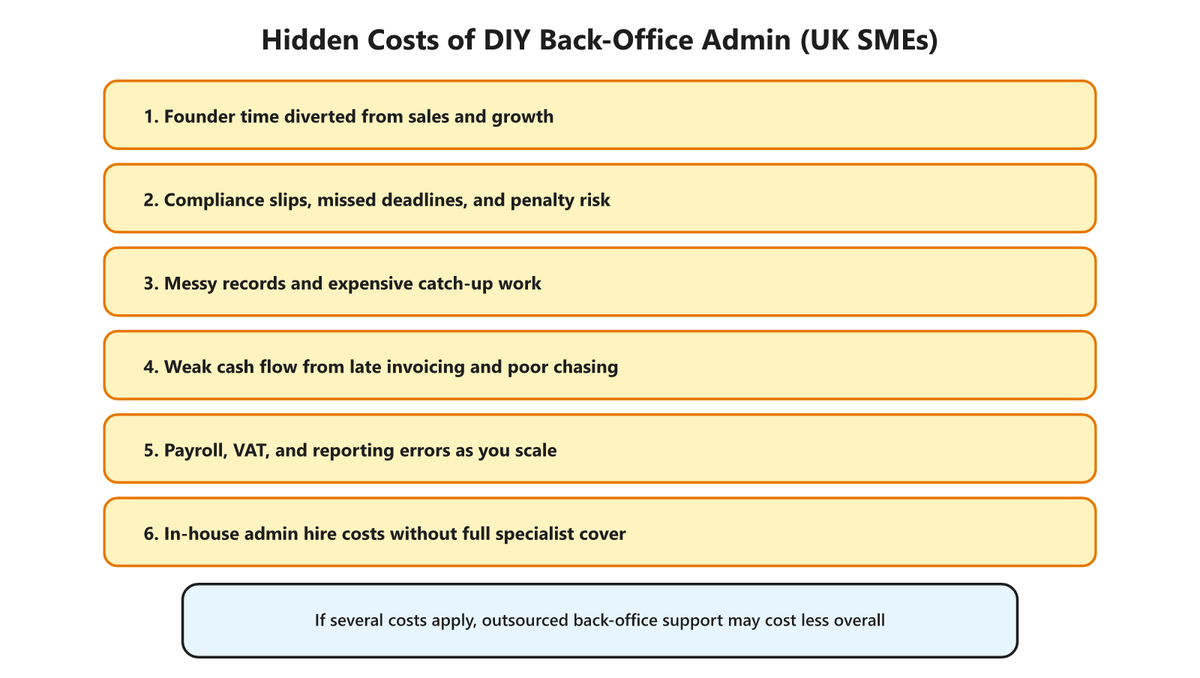
1. Founder time diverted from growth
Every hour spent on admin is an hour not spent selling, delivering, hiring, or improving the product. For owners who bill clients or lead revenue, that trade-off is expensive even when no invoice is sent for the admin work.
DIY back-office admin often expands in small increments. One more invoice run. One more supplier query. One more spreadsheet. The total time cost is easy to ignore until the business feels permanently behind.
2. Compliance slips and penalty risk
UK businesses must meet ongoing obligations for tax, payroll, VAT, and company filings. HMRC guidance on keeping records makes clear that poor records create compliance risk, not just admin inconvenience.
For example, limited companies normally need to keep accounting records for six years from the end of the relevant financial year, and sometimes longer in specific cases. Self-employed businesses must keep tax records for at least five years after the 31 January submission deadline for the relevant tax year.
Missed deadlines, payroll filing errors, or weak audit trails create costly corrections. VAT compliance risk is not only theoretical. For VAT periods starting on or after 1 January 2023, HMRC uses a points-based late-submission penalty system, with potential fixed penalties once thresholds are reached, plus late-payment penalties and interest.
From 18 November 2025, new Companies House identity verification requirements add another admin touchpoint for directors and PSCs, so document discipline and adviser coordination matter more than ever.
DIY admin often breaks down at busy periods exactly when compliance risk rises.
3. Messy records and expensive catch-up work
When records slip for a few months, the fix is rarely quick. Catch-up bookkeeping, reconciliation, and correction work costs more than steady monthly support.
That is one reason outsourced bookkeeping and admin often makes sense before the problem becomes urgent. Cleanup is often more expensive than steady monthly maintenance because records may need to be reconstructed before they can be corrected.
4. Weak cash flow from poor invoicing and chasing
Back-office admin directly affects cash. Late invoices, inconsistent payment chasing, and unclear debtor lists delay money coming in.
If cash keeps tightening despite decent sales, the issue may be process, not demand. Stronger cash flow forecasting often starts with basic admin discipline: invoices raised promptly, debtor lists reviewed regularly, and payment promises followed up.
5. Payroll, VAT, and reporting errors as you scale
Growth adds complexity. More employees mean payroll rules, pensions, and RTI reporting. Higher turnover can trigger VAT registration, and once registered, the business needs reliable VAT records, submission routines, and payment planning.
DIY admin that worked at startup stage often fails when transaction volume rises. Errors at this stage are harder to spot and more costly to unwind. See our UK payroll cost guide if payroll is becoming a pressure point.
6. Hiring in-house admin without full specialist cover
Some SMEs respond by hiring an office administrator. That can help, but one generalist may not cover payroll, VAT, management reporting, and compliance coordination equally well.
You still pay salary, employer National Insurance, pension, training, cover for absence, and management time. Compare that total with outsourced support priced by scope and deliverables.
Hidden cost | What it often looks like | Why it matters |
Founder time | Evenings and weekends on admin | Less focus on revenue and strategy |
Compliance risk | Late filings, weak records | Penalties and adviser clean-up fees |
Catch-up work | Months of backlog | Higher fees than ongoing support |
Cash flow drag | Late invoices and poor chasing | Payroll and tax pressure |
Scaling errors | Payroll/VAT mistakes as you grow | Harder fixes and lost confidence |
In-house hire | One admin generalist | May not cover full finance stack |
Example: The Real Cost of 6 Hours of DIY Admin per Week
Hidden costs become clearer with a simple worked example.
If a founder's commercial time is worth £75 per hour, six hours a week of admin represents £450 of opportunity cost. Over a month, that is roughly £1,800 of time before you factor in errors, delayed invoices, or catch-up fees.
That figure is illustrative, not a market benchmark. Your own hourly value may be higher or lower. The point is that DIY admin has a real price even when no invoice is sent for the work.
Compare that monthly time cost with outsourced administration support from £249/mo on AMS published starting prices. The maths often shifts once you include compliance risk and catch-up work, not just founder hours alone.
DIY vs Outsourced Back-Office Support
Factor | DIY back-office admin | Outsourced back-office support |
Upfront cost | Looks low (software + your time) | Clear monthly fee |
Time burden | Falls on owner or busy staff | Handled by dedicated support |
Consistency | Depends on how busy you are | Built around agreed routines |
Compliance support | Easy to miss under pressure | Usually part of scoped service |
Scalability | Strains as volume grows | Can expand with service tiers |
Best for | Very early stage, low volume | Growing SMEs with recurring admin load |
Outsourcing does not mean giving up control. It means agreeing what is done, when, and how you receive reporting. The right provider should make numbers and processes clearer, not less visible.
When UK SMEs Should Outsource Back-Office Admin
Consider outsourcing when several of these signs apply:
- you are behind on bookkeeping or reconciliations
- invoices and supplier payments are often late
- you dread month-end or VAT periods
- your accountant keeps asking for missing information
- payroll or compliance tasks feel constantly rushed
- you cannot explain cash position without rebuilding spreadsheets
- growth has added admin work faster than your processes
- you are hiring staff but still doing most admin yourself
If finance reporting is also slipping, you may need more than admin alone. Our guide on when to hire a financial controller explains when stronger finance control is warranted.
If the bigger question is strategic finance leadership, see virtual CFO vs outsourced finance admin.
What to Outsource First
You do not need to outsource everything on day one. A sensible order for many UK SMEs is:
- Bookkeeping and reconciliations so records stay current
- Invoicing and payment chasing to protect cash flow
- VAT and payroll coordination as complexity increases
- Management reporting support when decisions need monthly numbers
Match the scope to what is actually slipping. If only bookkeeping is the problem, start there. If the whole back office is under strain, a bundled administration package may be more efficient.
When comparing providers, use the same discipline as our accountant prices UK guide: compare deliverables, not just headline fees.
How AMS Admin Services Helps UK SMEs
AMS Admin Services supports UK SMEs that want to step away from DIY back-office overload without building a full in-house team.
AMS service | Published starting point | Typical back-office support |
from £249/mo | Accounts management, AP/AR, software setup | |
from £319/mo | Payroll processing and employer compliance support | |
from £349/mo | Bookkeeping, VAT, management accounts, cashflow support |
That lets you outsource the tasks draining founder time while keeping compliance and reporting aligned. We explain what is included, recommend the right starting level, and help you scale support as the business grows.
Book a free consultation and we will identify which back-office tasks are costing you the most time, where compliance risk may be building, and what level of AMS support fits your current workload.
Common Mistakes When Deciding to Outsource
Waiting until cleanup is urgent
The most expensive time to outsource is after months of backlog. Start when admin first starts slipping, not when deadlines are already at risk.
Choosing on price alone
The cheapest quote may exclude payment chasing, reconciliations, or adviser coordination. Compare scope carefully.
Keeping DIY and outsourced work uncoordinated
If you still post some transactions yourself while a provider does the rest, agree clear responsibilities. Mixed processes create gaps.
Outsourcing without reviewing cash and reporting rhythm
Admin support should improve visibility. Ask how often you will receive updates on debtors, cash, and open tasks.
Ignoring compliance touchpoints
Companies House filings, VAT, and payroll all connect to admin quality. Weak document discipline makes each filing harder, slower, and more expensive to fix.
Frequently Asked Questions
What are the hidden costs of DIY back-office admin?
The biggest hidden costs are founder time, compliance risk, catch-up bookkeeping, weak cash collection, scaling errors in payroll and VAT, and the full cost of hiring in-house admin staff.
When should a UK SME outsource back-office admin?
Outsource when admin backlogs are recurring, compliance tasks feel rushed, cash flow suffers from poor invoicing, or growth has outpaced your internal processes.
Is outsourced bookkeeping worth it for small businesses?
For many UK SMEs, yes. Steady outsourced bookkeeping often costs less overall than catch-up work, missed deadlines, and founder time lost to records.
What is the difference between admin support and bookkeeping?
Admin support covers wider operational tasks such as invoicing, payment chasing, and document workflows. Bookkeeping focuses on recording and reconciling transactions. Many businesses need both.
Can AMS replace all back-office admin?
AMS can handle a substantial share of routine back-office work through administration, payroll, and accounting services. We scope support to your needs rather than forcing a one-size package.
How much does outsourced back-office support cost?
Fees depend on transaction volume, services included, and reporting needs. AMS publishes starting prices on our service pages and provides personalised quotes after a free consultation.
Should I outsource admin before hiring a full-time office manager?
Often yes. Outsourced support can cover specialist tasks immediately without recruitment delay. Hire in-house when volume justifies a dedicated role and clear internal oversight.
What is the first step if DIY admin is overwhelming?
List what is slipping: records, invoices, payroll, VAT, or cash chasing. Contact AMS for a free consultation and we will recommend the right starting level of support.
Disclaimer
This article is for general information only. It is not tax, legal, or financial advice. HMRC rules, GOV.UK guidance, and filing requirements can change. Speak to a qualified accountant or adviser for advice tailored to your business.
Final Thoughts
DIY back-office admin can work at the very early stage. It becomes expensive when it steals founder time, weakens compliance, delays cash, and turns into catch-up projects.
The question is not whether admin matters. It does. The question is whether you are still the best person to carry it as the business grows.
If hidden costs are building up, outsourcing is often a practical step rather than a luxury. Start with the tasks slipping most, compare providers on deliverables, and build support in layers.
If you want UK back-office support with clear pricing and one team for admin, payroll, and accounting, AMS Admin Services can help. Book a free consultation and find out what level of outsourced support fits your business today.