Blog
How Much Does Payroll Cost for a UK Small Business in 2026? In-House vs Outsourced Explained
Magnolia Roy | 23 July 2026
A practical 2026 guide to UK payroll costs for small businesses: in-house vs outsourced, what drives fees, hidden time costs, and how to compare quotes fairly.
How Much Does Payroll Cost for a UK Small Business in 2026? In-House vs Outsourced Explained
If you employ staff in the UK, payroll is not optional. Every pay run involves calculations, payslips, pension duties, and reporting to HMRC. The real question for many small business owners is not whether to run payroll, but how much it costs to do it in-house versus outsourcing it.
Payroll cost is rarely one simple number. It includes software, your time, corrections, and the risk of missing a deadline. In 2026, with more employers hiring and compliance expectations rising, comparing in-house vs outsourced payroll fairly matters more than chasing the lowest monthly quote.
This guide explains what UK small businesses pay for in payroll, what affects fees, and how to decide which route fits your business.
What UK Employers Pay for When They Run Payroll
Payroll is more than transferring wages. As an employer operating PAYE, you must:
- calculate pay, tax, and National Insurance
- produce payslips
- report to HMRC on or before payday
- pay HMRC what you owe, usually monthly
- manage pension auto-enrolment duties where applicable
- run year-end payroll reporting
GOV.UK guidance on PAYE for employers explains that PAYE is HMRC's system to collect Income Tax and National Insurance from employment. If you run payroll yourself, you report employee payments and deductions to HMRC on or before each payday.
GOV.UK guidance on running payroll sets out monthly tasks including Full Payment Submissions (FPS), Employer Payment Summaries (EPS) where needed, and paying HMRC by the 22nd of the month (or the 19th if paying by post).
When you ask how much does payroll cost, you are really asking what it costs to do all of this correctly, every month, without errors.
In-House vs Outsourced Payroll: What Is the Difference?
Factor | In-house payroll | Outsourced payroll |
Who runs pay calculations | You or an internal staff member | Payroll bureau, accountant, or provider |
Software | You choose and operate payroll software | Provider uses software (may be included in fee) |
HMRC reporting (FPS/EPS) | You submit via your software | Provider submits on your behalf |
Payslips | You generate and distribute | Provider usually supplies |
Your time | Higher, especially while learning | Lower once processes are set |
Legal responsibility | You remain the employer responsible to HMRC | You remain responsible even if outsourced |
Best fit | Very small teams, simple pay structures | Growing teams, variable pay, limited admin time |
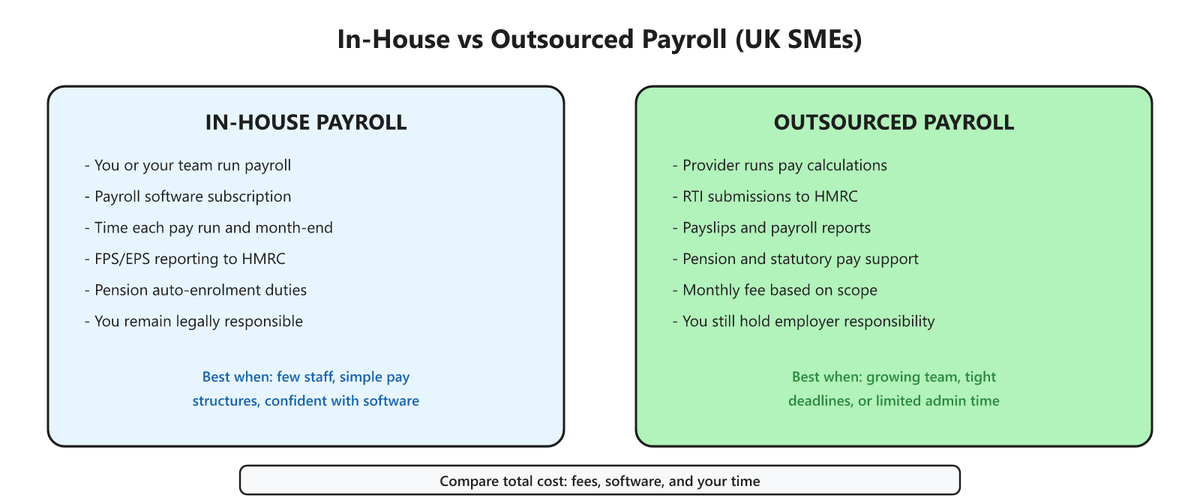
GOV.UK states you can operate PAYE by paying a payroll provider or doing it yourself using payroll software. It also makes clear that as an employer, you are legally responsible for completing all PAYE tasks, even if you pay someone else to do them.
What Affects Payroll Cost in the UK?
Payroll fees vary because businesses vary. Whether you outsource or run payroll internally, these factors change the total cost.
Cost driver | Why it matters |
Number of employees | More employees means more calculations, payslips, and reporting lines |
Pay frequency | Weekly payroll usually costs more to process than monthly |
Pay complexity | Commission, overtime, expenses, directors' pay, and benefits add work |
Pension auto-enrolment | Setup and ongoing pension duties increase admin |
Statutory pay | Sick pay, maternity, paternity, and adoption pay can affect reporting |
Starter and leaver churn | Frequent joiners and leavers create extra submissions |
Software and support | In-house payroll needs software licences and possibly training |
Correction history | Messy records or past errors often cost more to fix |
There is no single national payroll price that applies to every UK small business. Compare quotes based on your employee numbers and pay complexity, not a generic average.
The Real Cost of In-House Payroll
In-house payroll often looks cheaper because the software fee is visible and the monthly provider invoice is avoided. The hidden cost is time and risk.
Direct in-house costs
Typical direct costs include:
- payroll software subscription
- pension scheme setup and ongoing administration support
- training or external help when rules change
- possible accountancy support at year-end for PAYE reconciliation
Hidden in-house costs
Less visible costs include:
- hours spent each pay run by the owner or office manager
- time fixing errors after HMRC notices or employee queries
- stress around deadlines if the person running payroll is also client-facing
- opportunity cost of doing payroll instead of revenue-generating work
GOV.UK warns that late, missing, or incorrect payroll reports can lead to penalties and can affect employees' income-related benefits. For new employers, HMRC may close your PAYE scheme if you do not send a report or pay within 120 days.
In-house payroll can work well when you have one or two employees, simple monthly pay, and someone confident using software. It becomes expensive quickly when pay runs start eating half a day every month and still feel risky.
The Real Cost of Outsourced Payroll
Payroll outsourcing UK providers typically charge a monthly fee based on how many employees you have and what is included. Some charge per payslip. Others bundle pension support, RTI submissions, and year-end reporting.
What outsourced payroll usually includes
Service | Often included | Ask before you sign |
Pay calculations | Yes | Commission, expenses, back pay |
FPS submissions to HMRC | Yes | EPS handling |
Payslips | Yes | Employee self-service portal |
Pension auto-enrolment | Sometimes | Setup vs ongoing only |
Statutory pay claims | Sometimes | Maternity, paternity, sick pay |
Year-end reporting | Sometimes | P11D or benefits reporting |
HR advice | Rarely | Separate service |
Always get the scope in writing. A low headline fee may exclude pension duties, leaver processing, or catch-up work.
When outsourced payroll saves money
Outsourcing often makes sense when:
- you employ more than a handful of staff
- pay varies week to week
- you have missed deadlines or made errors before
- no one internally wants to own RTI reporting
- you are hiring quickly and need payroll stable while you grow
You still need to provide accurate employee data and approve payroll before it is submitted. Outsourcing reduces execution risk; it does not remove employer responsibility.
In-House vs Outsourced: How to Compare Total Cost Fairly
Use the same checklist for both options:
- Count employees and pay frequency (monthly vs weekly).
- List pay complexity (commission, benefits, directors, pensions).
- Estimate internal hours per month at your own hourly cost.
- Add software and pension admin fees for in-house.
- Request a written outsourced quote that states what is included.
- Include cost of fixing errors if history is messy.
Comparison step | In-house | Outsourced |
Monthly software | Yes | Often included |
Provider fee | No | Yes |
Owner/manager time | Usually high | Usually lower |
Training and updates | Your time | Often included |
Penalty risk if late | You carry it | Shared, but you remain liable |
Scales with headcount | Time rises sharply | Fee rises predictably |
If you are also comparing wider back-office support, see our guides on bookkeeping vs accounting vs admin support and UK accountant prices in 2026.
Payroll Cost vs Accounting Cost: Do Not Confuse Them
Payroll and accounting overlap but are not the same service.
Area | Payroll | Accounting |
Main focus | Employee pay and PAYE | Business records, VAT, year-end accounts |
HMRC interaction | FPS, EPS, PAYE payments | VAT returns, Corporation Tax, Self Assessment |
Frequency | Every pay run | Monthly or annual |
Typical provider | Payroll bureau or accountant | Accountant or bookkeeper |
Some firms bundle payroll with accounting. Others price them separately. If you are a new employer, you may also need help registering for PAYE first. See our register for PAYE checklist before your first payday.
What About PAYE, National Insurance, and Pension Duties?
Your payroll bill is separate from the tax and National Insurance you pay HMRC as an employer.
GOV.UK explains that you deduct tax and National Insurance from employee pay and may need to deduct student loan repayments or pension contributions. Your payroll software calculates employer National Insurance on employee earnings above the relevant threshold.
Workplace pension duties are a major employer obligation. GOV.UK employer step-by-step guidance links to pension responsibilities when you take on employees. Auto-enrolment adds setup and ongoing tasks that many owners underestimate when pricing payroll in-house.
None of this replaces the need for accurate payroll processing. It is part of why outsourced payroll often looks better value once headcount grows.
How AMS Admin Services Approaches Payroll Pricing
AMS Admin Services provides straightforward payroll support for UK small businesses. We believe fees should be clear before work starts, with no vague promises about what is included.
Published starting point on our website (confirm your personalised quote in a free consultation):
AMS service | Published starting point | Typical scope |
from £319/mo | Payroll processing, RTI reporting, pension support |
Your actual fee depends on employee numbers, pay frequency, complexity, and the services you need. We offer a free consultation and personalised quote so you only pay for payroll support that matches your business.
We can also support wider compliance and back-office work through our compliance services and administration services if you want one team handling more than payroll alone.
Common Payroll Cost Mistakes UK SMEs Make
Choosing on monthly fee alone
The cheapest quote may exclude pension duties, EPS submissions, or leaver processing.
Ignoring your own time
Ten hours a month of owner time at a busy billing rate can exceed a provider fee.
Running payroll in-house without proper training
GOV.UK payroll reporting guidance sets out detailed FPS and EPS requirements. Guessing your way through submissions is expensive when corrections are needed.
Not updating payroll when pay changes
New benefits, salary changes, and pension alterations affect reporting. Stale setups create year-end problems.
Assuming outsourcing removes all responsibility
You must still provide accurate employee data and respond to HMRC as the employer.
Frequently Asked Questions
How much does payroll cost for a small business in the UK?
Costs depend on employee numbers, pay frequency, complexity, and whether you run payroll in-house or outsource. Compare total cost including software, time, and provider fees rather than a single headline number.
Is it cheaper to run payroll in-house or outsource?
In-house can cost less for very simple payroll with few employees if you are confident with software and have time. Outsourcing often costs less overall when pay is complex, headcount is growing, or errors and deadlines are a concern.
What is included in outsourced payroll services?
Typically pay calculations, RTI submissions, and payslips. Pension auto-enrolment, statutory pay, and year-end reporting may be extra. Always check the written quote.
Who is legally responsible for payroll mistakes?
The employer remains legally responsible for PAYE tasks even when using a payroll provider. GOV.UK states this clearly.
How much does AMS charge for payroll?
AMS publishes payroll and employee services from £319/mo on our website. Your personalised quote depends on your business. Contact us for a free consultation.
Do I need payroll software if I outsource?
Your provider usually operates payroll software on your behalf. You still need to supply accurate employee information and approve payroll before submission.
When should a UK small business outsource payroll?
Consider outsourcing when you are hiring regularly, pay is variable, you lack internal payroll expertise, or payroll is taking too much owner time.
How do I register for PAYE before running payroll?
New employers must register with HMRC and set up PAYE before paying staff. Our PAYE registration checklist walks through the steps.
Final Thoughts
Payroll cost for a UK small business in 2026 is about more than a monthly invoice. It is software, time, compliance, pension duties, and the cost of getting it wrong. In-house payroll can work for simple setups. Outsourced payroll often wins when complexity and headcount grow.
The best approach is to compare total cost fairly, check what is included in writing, and choose the option you can sustain every pay run, not just the first one.
If you want clear payroll pricing and reliable support for PAYE, RTI, and pensions, AMS Admin Services can help. Book a free consultation and get a quote built around your team, not a generic package.