Blog
Payroll vs Accounting: What's the Difference and Why UK SMEs Need Both
Magnolia Roy | 19 July 2026
A practical UK guide explaining payroll vs accounting, what each function covers, and why most growing SMEs need both working together rather than choosing one.
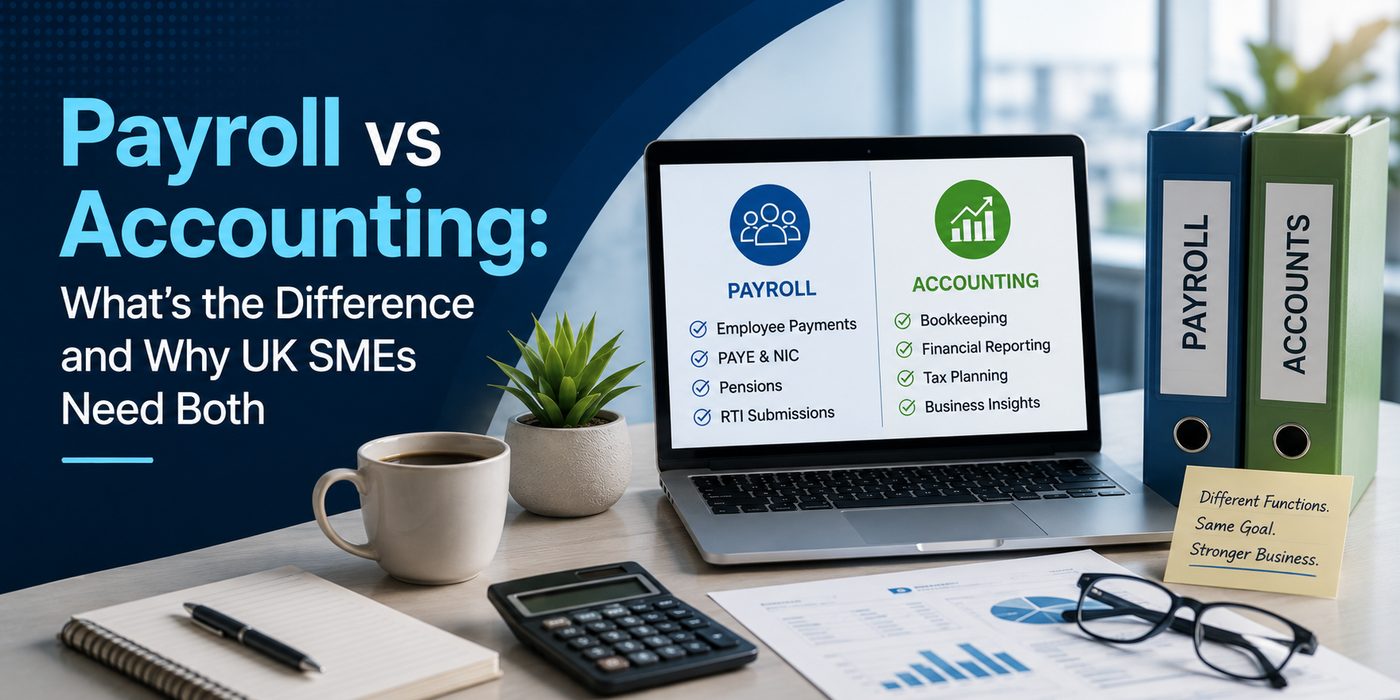
Payroll vs Accounting: What's the Difference and Why UK SMEs Need Both
Many UK business owners treat payroll and accounting as the same thing because both involve numbers, HMRC, and monthly deadlines.
They are related, but they are not the same job.
Payroll is about paying people correctly and meeting employer compliance obligations. Accounting is about recording the wider financial picture, reporting accurately, and supporting tax and business decisions.
When the two are confused, businesses often under-scope support, duplicate work, or miss problems until year-end.
This guide explains payroll vs accounting, what each covers, and why most growing UK SMEs need both working together.
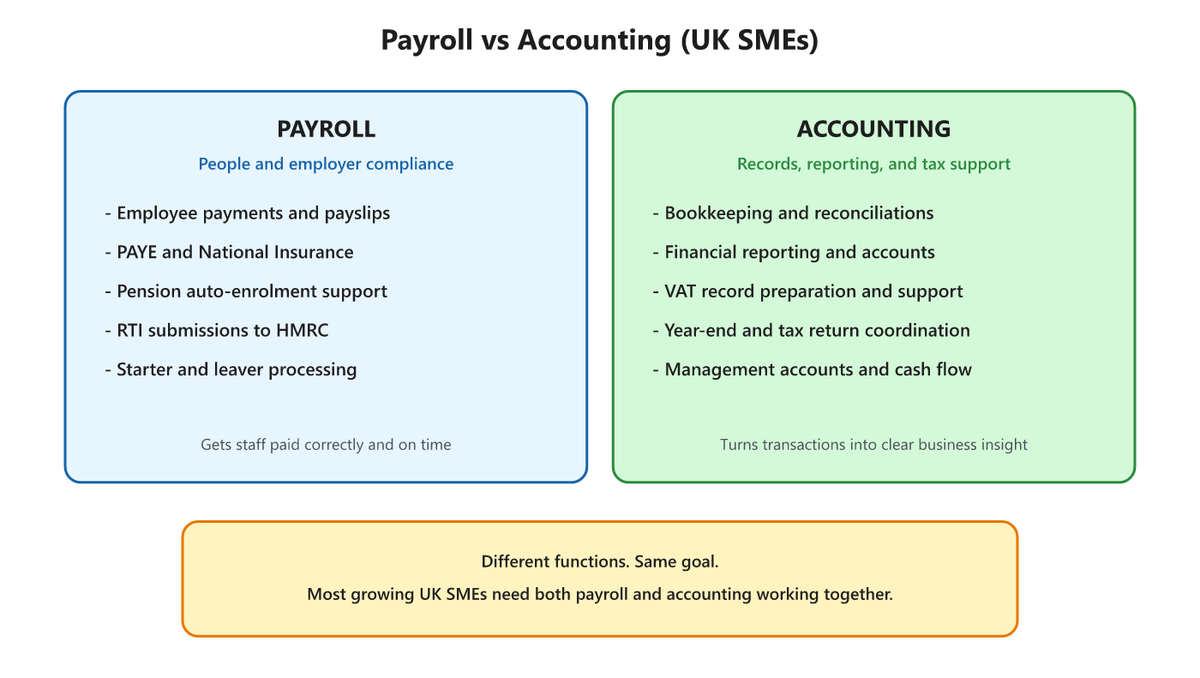
Quick answer: Payroll manages employee pay, PAYE, National Insurance, pensions, payslips, and RTI submissions. Accounting covers the wider business finances, including bookkeeping, VAT records, management accounts, tax coordination, cash flow, and reporting. Most UK SMEs with employees need both working together.
What Is Payroll?
Payroll is the process of paying employees and meeting UK employer obligations linked to those payments.
Typical payroll responsibilities include:
- calculating gross pay, deductions, and net pay
- issuing payslips
- processing PAYE income tax and National Insurance
- handling pension auto-enrolment where applicable
- submitting Real Time Information (RTI) returns to HMRC
- managing starters, leavers, and pay changes
- coordinating statutory payments such as sick pay or parental pay where relevant
If you employ staff, payroll is not optional. GOV.UK guidance on running payroll makes clear that PAYE must be operated and reported correctly, including RTI submissions on or before payday.
New employers must register as an employer with HMRC before the first payday. Our PAYE registration checklist walks through the first steps.
Employers must also follow GOV.UK rules on keeping PAYE records, including pay, deductions, and reports submitted to HMRC. For typical UK payroll costs, see our UK payroll cost guide.
What Is Accounting?
Accounting is broader. It covers how the whole business records, reports, and understands its finances.
Typical accounting responsibilities for UK SMEs include:
- bookkeeping and bank reconciliations
- preparing management accounts
- VAT record preparation and reporting support where included in scope
- year-end accounts and tax return coordination
- cash flow tracking and financial reporting
- advising on business structure, tax timing, and compliance planning
Accounting uses payroll data, but it also covers sales, purchases, assets, liabilities, and the wider picture directors need to run the business.
Where VAT applies, businesses must also meet GOV.UK VAT record-keeping requirements, including sales, purchases, and VAT accounts.
Accounting is not the same as bookkeeping or wider admin support. See bookkeeping vs accounting for a fuller breakdown.
Payroll vs Accounting at a Glance
Area | Payroll | Accounting |
Main focus | Employee pay and employer compliance | Business records, reporting, and tax support |
Typical timing | Every pay run and monthly RTI | Ongoing records plus month-end and year-end |
Main HMRC touchpoint | PAYE / RTI | VAT, Corporation Tax, Self Assessment, and wider reporting |
Who it affects most | Employees and directors paid through payroll | Owners, directors, investors, and lenders |
Common owner mistake | Assuming payroll is just pressing a button | Assuming accounting only matters once a year |
Best outcome | Staff paid correctly, on time, and compliantly | Clear numbers and reliable reporting |
A useful rule: payroll keeps people paid. Accounting keeps the business understood.
Where Payroll and Accounting Overlap
Payroll and accounting connect in several important places:
- payroll costs feed into profit and loss reporting
- PAYE and National Insurance liabilities affect cash flow
- pension contributions need recording correctly
- director pay and dividends must align with wider accounts
- year-end accounts rely on accurate payroll data
- management reporting is weaker if payroll and bookkeeping are out of step
That overlap is why many SMEs benefit from payroll and accounting support that is coordinated, whether in-house, outsourced, or split between a payroll provider and an accountant.
Directors and owners still need oversight. The aim is to make pay runs, liabilities, and reporting clearer, not less visible.
Why UK SMEs Usually Need Both
Most growing UK businesses need both functions because they solve different problems.
You need payroll when you employ staff
As soon as you have employees, payroll compliance becomes ongoing. Missed RTI submissions, incorrect deductions, or late payments can create employee trust issues and HMRC problems.
You need accounting as the business becomes more complex
Even with payroll handled, you still need reliable bookkeeping, VAT support, year-end reporting, and management insight. Payroll alone does not tell you whether the business is profitable, cash-healthy, or ready to grow.
You need both when decisions depend on complete numbers
Hiring plans, pricing, funding conversations, and tax planning all depend on payroll and accounting data lining up. If one side is weak, the other becomes less useful.
For many SMEs, the question is not payroll or accounting. It is how to run both well without the founder becoming the link between every system. If you are weighing what to keep in-house versus outsource, see front office vs back office.
Example: How Payroll and Accounting Work Together
A growing design agency with six employees may outsource payroll so payslips, PAYE, pensions, and RTI are handled on schedule. At the same time, it needs accounting support for bookkeeping, VAT records, management accounts, and year-end coordination.
Payroll makes sure the team is paid correctly. Accounting makes sure the owner can see wage costs, cash flow, and profit clearly enough to decide whether to hire again.
Neither function replaces the other. Together they give the business control.
When You Might Need One Before the Other
Business stage | Payroll need | Accounting need |
Sole trader with no employees | Usually low | Often needed for tax and records |
First employee hired | Becomes essential | Still needed for wider reporting |
VAT-registered growing SME | Essential with staff | Becomes more important monthly |
Multi-employee business | Core compliance function | Core reporting and control function |
If you are comparing payroll costs, see our UK payroll cost guide. If you are comparing wider finance support, see accountant prices UK.
How AMS Admin Services Helps UK SMEs
AMS Admin Services helps UK SMEs run payroll and accounting support in a more coordinated way.
AMS service | Published starting point | Typical support |
from £319/mo | Payroll processing, RTI reporting, pension support | |
from £349/mo | Bookkeeping, VAT record preparation, management accounts, cashflow support |
That means payroll and wider accounting support can be aligned under one team rather than treated as separate problems.
Book a free consultation and we will review your current payroll setup, accounting records, and where support should be strengthened first.
Common Mistakes When Managing Payroll and Accounting
Assuming payroll is just accounting
Payroll has its own compliance rhythm, deadlines, and employee-facing consequences.
Treating accounting as year-end only
By the time annual accounts are due, weak monthly records are harder and more expensive to fix.
Using payroll data that never reaches the books properly
Wage costs, pensions, and PAYE liabilities should flow cleanly into accounting records.
Splitting providers with no coordination
If payroll and accounting are handled separately, agree who owns reconciliations, journals, and reporting handovers.
Doing both yourself for too long after hiring
Founder-led payroll and bookkeeping often work early on, but errors and time cost rise quickly as headcount grows. See the hidden costs of DIY back-office admin for a fuller picture.
Frequently Asked Questions
What is the difference between payroll and accounting?
Payroll focuses on employee payments and employer compliance such as PAYE, NI, pensions, and RTI. Accounting covers wider business records, reporting, VAT support, and tax coordination.
Do UK SMEs need both payroll and accounting?
Most growing businesses with employees need both. Payroll handles pay and employer compliance. Accounting handles the wider financial picture.
Can one provider do payroll and accounting?
Yes. Many SMEs use one firm or coordinated providers for both so wage costs, liabilities, and reporting stay aligned.
Is payroll included in accounting services?
Sometimes partially, but not always. Always check whether payroll processing, RTI, and pension support are included or priced separately.
When should a UK business outsource payroll?
Consider outsourcing when pay runs take too much time, compliance feels risky, or payroll errors are becoming more frequent as headcount grows.
What is the first step if payroll and accounts feel disconnected?
Review your latest pay run, PAYE liabilities, and bookkeeping records together. Contact AMS for a free consultation and we will recommend the right level of support.
Disclaimer
This article is for general information only. It is not tax, legal, or financial advice. HMRC rules, GOV.UK guidance, and filing requirements can change. Speak to a qualified accountant or adviser for advice tailored to your business.
Final Thoughts
Payroll vs accounting is not really a choice between two similar services. They solve different problems and connect at several important points.
Payroll keeps employees paid and employer obligations on track. Accounting turns the wider business numbers into something you can trust and act on.
Most UK SMEs do not need to choose one over the other. They need both working together with clear oversight.
If you want payroll and accounting support under one roof, AMS Admin Services can help. Book a free consultation and find out how to align pay runs, records, and reporting for your business.