Blog
What Are Management Accounts and When Does a UK SME Actually Need Them?
Magnolia Roy | 08 August 2026
A practical UK guide to management accounts for SMEs: what they include, how they differ from statutory year-end accounts, and when regular reporting is worth the investment.
What Are Management Accounts and When Does a UK SME Actually Need Them?
If you run a UK small or medium-sized business, you already know you must keep accounting records and file statutory accounts each year. But many growing SMEs reach a point where year-end figures alone are not enough to run the business day to day.
That is where management accounts come in. They are regular financial reports prepared for you and your management team, not for Companies House. This guide explains what management accounts are, how they differ from statutory accounts, what they usually include, and when a UK SME actually needs them.
What Are Management Accounts?
Management accounts are internal financial reports that show how your business is performing over a shorter period, typically monthly or quarterly. They turn your bookkeeping data into clear information you can use to make decisions, manage cash, and spot problems early.
Unlike your annual statutory accounts, management accounts are designed for owners, directors, and managers. They can be tailored to your business, your sector, and the questions you need answered right now. For example:
- Are we on track against budget?
- Which product lines or jobs are most profitable?
- Can we afford to hire or invest this quarter?
- Is cash flow tight before VAT or Corporation Tax is due?
Management accounts are not a replacement for proper bookkeeping or year-end compliance. They build on the same underlying records, but present them in a more timely, decision-focused way.
Why UK SMEs Ask About Management Accounts
Most owner-managed businesses start with basic bookkeeping and annual accounts. That works well at first. As turnover grows, staff increase, or funding becomes more complex, directors often want more frequent visibility than a once-a-year report can provide.
Search interest around management accounts for small business usually reflects that shift: the business is growing, but the owner still feels they are reacting late to financial problems. Regular management reporting helps close that gap.
Management Accounts vs Statutory Accounts
This is one of the most important distinctions for UK company directors. Statutory accounts are a legal requirement. Management accounts are a management tool.
According to GOV.UK guidance on preparing annual accounts, your company's statutory accounts are prepared from financial records at the end of the financial year. They must be sent to shareholders, filed with Companies House, and submitted to HMRC as part of your Company Tax Return.
GOV.UK also sets out filing deadlines for annual accounts with Companies House and Corporation Tax obligations with HMRC. Those deadlines matter for compliance, but they do not give you a monthly view of performance.
Management accounts | Statutory accounts | |
Purpose | Run the business and make decisions | Meet legal filing and tax requirements |
Frequency | Often monthly or quarterly | Once per financial year |
Audience | Directors, owners, managers | Companies House, HMRC, shareholders |
Filing | Not filed publicly | Filed with Companies House and used for HMRC |
Content | Flexible: KPIs, budgets, commentary | Prescribed format: balance sheet, profit and loss, notes |
Timing | Recent trading period | Full financial year (historical) |
You still need both sets of records in the background. GOV.UK requires companies to keep accounting records that support annual accounts and tax returns. Management accounts use that same data, but repackage it for ongoing control.
What Do Management Accounts Usually Include?
There is no single legal format for management accounts in the UK. A good pack for an SME is clear, consistent, and easy to read without a finance degree.
Profit and Loss Report
Shows income, costs, and profit for the period and often year to date. Many packs compare actual results to budget or the same period last year.
Balance Sheet Snapshot
Summarises what the business owns and owes at the end of the period. Useful for checking debtors, creditors, and overall financial position.
Cash Flow Summary
Highlights money in and out. For many SMEs, this is the most urgent section, especially when VAT, PAYE, or Corporation Tax payments are due.
KPIs and Variance Analysis
Key performance indicators depend on your business. A retailer might track gross margin and stock. A contractor might track work in progress and job profitability. The goal is to show what changed and why.
Commentary in Plain English
Numbers alone rarely tell the full story. Short narrative commentary helps directors understand risks, opportunities, and recommended actions.
Budget or Forecast Comparison
If you have an annual budget or cash flow forecast, management accounts can show how actual performance compares to plan. That makes it easier to adjust spending or sales activity before small issues become serious.
When Does a UK SME Actually Need Management Accounts?
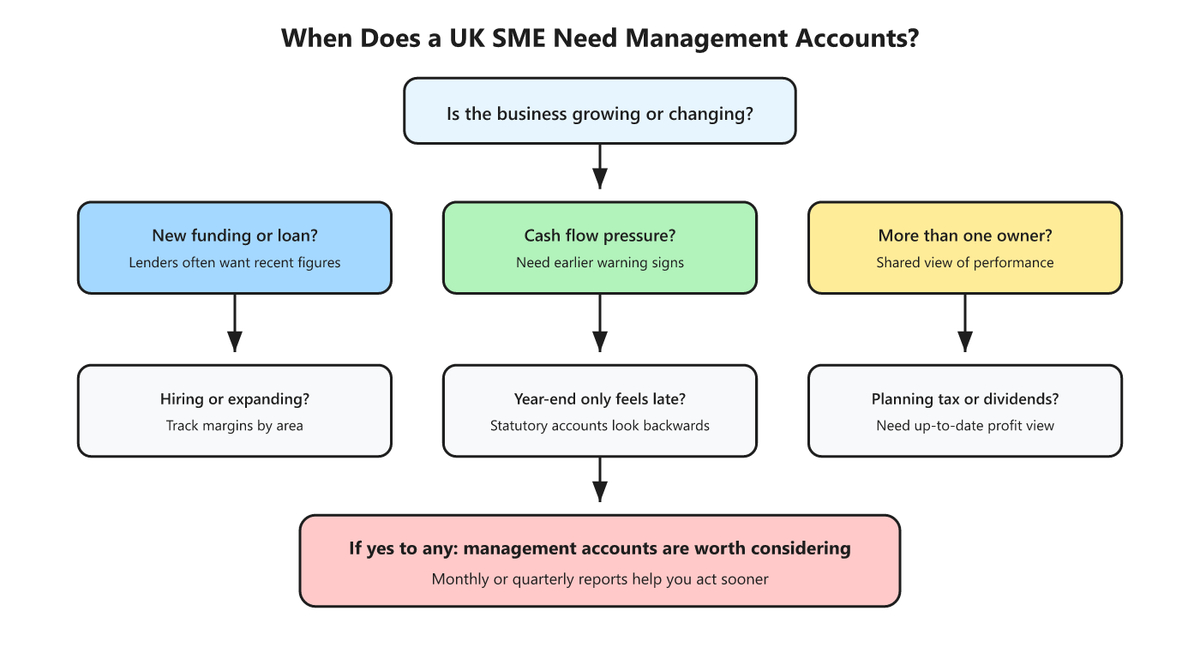
Not every sole trader or micro-business needs formal management accounts from day one. But there are clear signs that monthly or quarterly reporting is worth considering.
You Are Growing Faster Than Your Reporting
If turnover, staff, or locations are increasing, waiting for year-end accounts can leave you making decisions with outdated information. Management accounts give you a current picture while the year is still in progress.
Cash Flow Feels Tight or Unpredictable
Many UK SMEs are profitable on paper but short of cash at the wrong moment. Regular reporting helps you see pressure building before you miss supplier payments, tax deadlines, or payroll.
You Have Multiple Directors, Shareholders, or Investors
When more than one person has a stake in the business, shared, consistent reporting reduces disputes and improves alignment. Lenders and investors often ask for recent management information, not just last year's filed accounts.
You Are Seeking Funding or Renewing Finance
Banks and finance providers commonly request up-to-date profit and cash information. Management accounts prepared on a consistent basis are easier to share and support funding conversations.
You Are Planning Tax, Dividends, or Major Purchases
Directors often need a current view of retained profit before declaring dividends or making large capital purchases. Year-end accounts alone may be too old for that decision.
Year-End Accounts Answer "What Happened?" but Not "What Now?"
Statutory accounts look back at the full financial year. Management accounts help you look forward: what to fix this month, what to prioritise next quarter, and whether your strategy is working.
If none of these situations apply and your business is stable with simple finances, annual accounts and good bookkeeping may be enough for now. You can add management reporting when the business complexity grows.
How Often Should UK SMEs Prepare Management Accounts?
There is no legal rule on frequency because management accounts are not a filing requirement. Common approaches include:
Frequency | Best for |
Monthly | Growing SMEs, tight cash flow, multiple cost centres, or lender reporting |
Quarterly | Stable businesses that want regular oversight without monthly admin |
Ad hoc | Specific projects, funding rounds, or turnaround situations |
The right cadence depends on how fast your business changes and how quickly you need to act. Many UK SMEs start quarterly and move to monthly as they scale.
Management Accounts, Bookkeeping, and Year-End Accounts: How They Fit Together
Think of your finance function in layers:
- Bookkeeping records day-to-day transactions.
- Management accounts summarise recent performance for internal decisions.
- Statutory accounts and tax returns meet annual UK compliance obligations.
If bookkeeping is late or inaccurate, management accounts will be unreliable too. That is why many SMEs use the same accountant or finance partner for bookkeeping, management reporting, and year-end work. It keeps one consistent picture across the year.
Common Mistakes UK SMEs Make With Management Accounts
Treating Them as a Compliance Task
Management accounts are for running the business, not ticking a legal box. If nobody reads them or acts on them, they become an expense without benefit.
Using Only a P&L and Ignoring Cash
Profit does not always equal cash available. A useful pack should show both performance and liquidity.
Changing the Format Every Month
Consistency matters. Directors learn to read the pack quickly when layout and KPIs stay stable.
Waiting Until There Is a Crisis
The biggest value of management accounts is early warning: spotting margin squeeze, rising debtors, or cost overruns before they become a crisis.
How AMS Admin Services Can Help
AMS Admin Services supports UK SMEs with practical accounting and financial management, without unnecessary jargon. If you are unsure whether management accounts are right for your business, we can help you decide what level of reporting you actually need.
Our accounting and financial management services include:
- management account preparation with clear, timely reporting
- management accounting support for strategic decisions
- cash flow management and budgeting and forecasting
- KPI reporting tailored to your business
- bookkeeping, VAT, and statutory year-end accounts under one team
Whether you need monthly management accounts or quarterly reviews as you grow, we focus on reports you can use, not just numbers on a page.
FAQs
What are management accounts?
Management accounts are internal financial reports, usually prepared monthly or quarterly, that show how a UK business is performing. They help owners and directors make decisions and are not filed with Companies House.
Are management accounts a legal requirement in the UK?
No. UK limited companies must prepare and file statutory annual accounts with Companies House and use them for HMRC reporting. Management accounts are optional internal reports. See GOV.UK guidance on annual accounts.
What is the difference between management accounts and statutory accounts?
Statutory accounts are year-end accounts prepared for legal filing and shareholders. Management accounts are shorter-period reports for internal use and can include budgets, KPIs, and commentary. Statutory accounts must meet filing rules; management accounts are shaped around your business needs.
What are management accounts for a small business?
For a small business, management accounts typically include a profit and loss report, balance sheet snapshot, cash summary, and key variances against budget. They help you track growth, cash, and profitability without waiting for year-end.
How often should management accounts be prepared?
Many UK SMEs use monthly or quarterly management accounts. Monthly is common for growing businesses or tight cash flow. Quarterly can suit stable businesses that still want regular oversight.
Do I need management accounts if I already have an accountant?
You may still benefit from them. Year-end accounts look backwards and meet compliance needs. Management accounts look at recent trading and support forward decisions. Ask your accountant whether regular management reporting is included or available.
Can management accounts help with cash flow?
Yes. A good management accounts pack shows cash movement and upcoming pressures, not just profit. That helps directors plan tax payments, payroll, stock purchases, and investment with more confidence.
When should a UK SME start using management accounts?
Consider them when year-end information feels too late, cash is harder to predict, you have multiple stakeholders, you are seeking funding, or you are making bigger spending and hiring decisions. If your business is small and stable, annual accounts plus solid bookkeeping may be enough for now.
Final Thoughts
Management accounts give UK SMEs something statutory accounts cannot: a regular, practical view of how the business is doing while the year is still underway. They are not mandatory, but for many growing businesses they become essential once decisions need to be made faster than year-end reporting allows.
If you want clearer numbers, better cash visibility, and reporting you can actually use, AMS Admin Services can help. Book a free consultation to discuss management accounts, bookkeeping, and the right reporting rhythm for your business.