Blog
What Is Cash Flow Forecasting and How Can UK Small Businesses Use It?
Magnolia Roy | 24 July 2026
A practical UK guide to cash flow forecasting for small businesses: what it is, why profit and cash differ, how to build a simple forecast, and when to update it.
What Is Cash Flow Forecasting and How Can UK Small Businesses Use It?
Your profit and loss account can show a healthy month while your bank balance tells a different story. A large customer pays late. VAT falls due before invoices are settled. Payroll and rent leave on fixed dates regardless of when sales arrive.
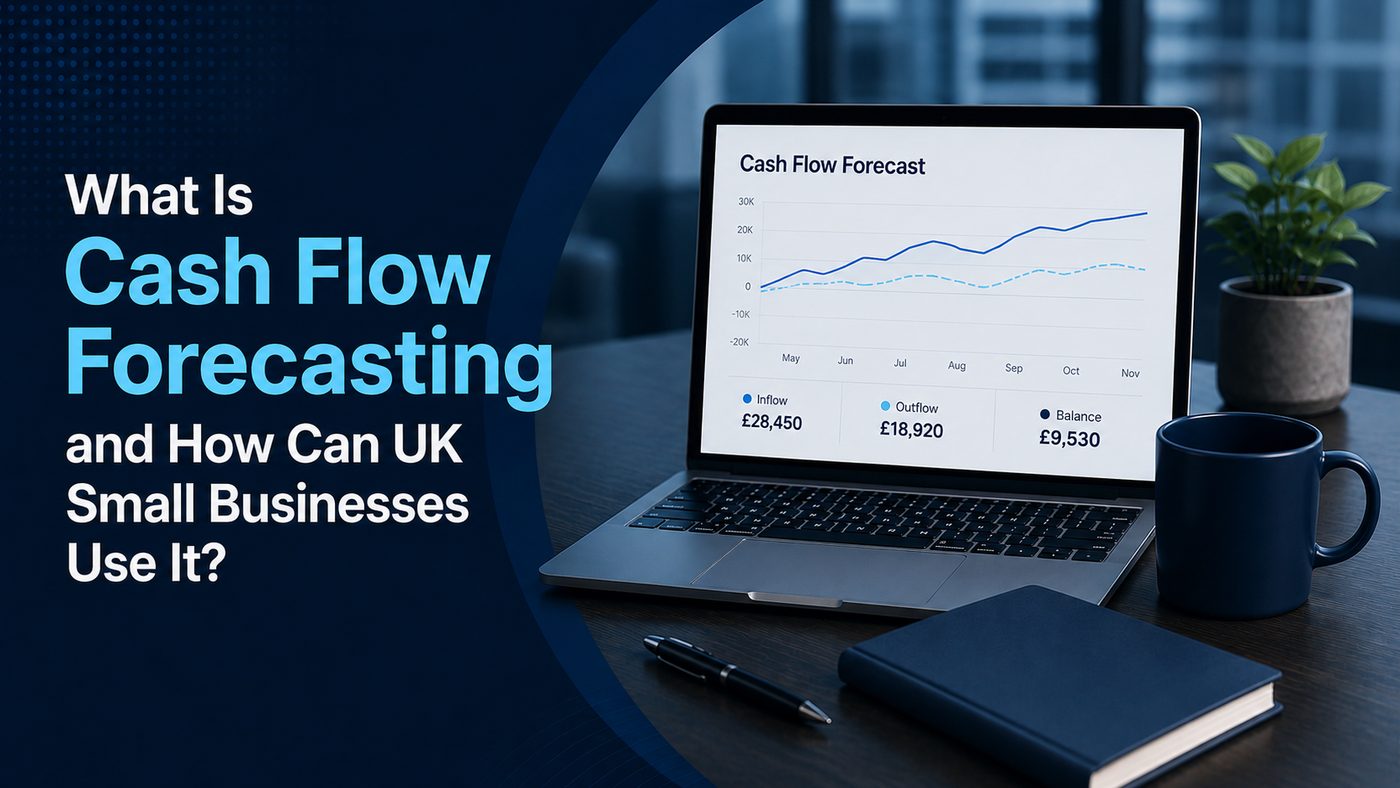
That gap between profit on paper and cash in the bank is why cash flow forecasting matters for UK small businesses. A cash flow forecast is a forward-looking plan that estimates money coming in and going out over the weeks or months ahead, so you can see whether you will have enough cash to operate, pay staff, meet tax deadlines, and invest in growth.
This guide explains what cash flow forecasting is, how it differs from profit reporting, how to build a practical forecast, and when UK SMEs should update it.
What Is Cash Flow Forecasting?
Cash flow forecasting means estimating your future cash position based on expected receipts and payments. It is not the same as your annual accounts or a profit and loss statement. Those reports look at income and expenses over a period, often on an accruals basis. A cash flow forecast focuses on when money actually moves.
For a UK small business, a simple forecast usually shows:
- opening cash balance (what is in the bank at the start of the period)
- cash inflows (customer payments, grants, loans, other receipts)
- cash outflows (payroll, rent, suppliers, tax, loan repayments)
- closing cash balance (what you expect to have left)
You repeat that calculation for each week or month in your forecast horizon. The result is a timeline of expected cash, not a guarantee. It is a planning tool that helps you spot pressure points early.
GOV.UK guidance on writing a business plan notes that a business plan should include a cash flow forecast, especially if you are seeking finance or managing growth. Even if you are not applying for funding, the same discipline helps day-to-day decisions.
Cash Flow vs Profit: Why They Are Not the Same
Many owners assume that if the business is profitable, cash will take care of itself. In practice, timing creates risk.
Factor | Profit (P&L view) | Cash flow view |
Customer invoices | Revenue may be recognised when invoiced | Cash arrives when the customer pays |
Supplier bills | Expense recorded when incurred | Cash leaves when you pay the bill |
VAT | May appear in accounts across periods | Cash payment to HMRC on set deadlines |
Equipment purchases | May be depreciated over years | Cash often paid upfront or via loan |
Director drawings / dividends | Not always in operating profit | Cash leaves the company when paid |
A business can be profitable and still run short of cash if customers pay slowly, if tax bills cluster in one month, or if you invest in stock or equipment ahead of sales. GOV.UK guidance on paying VAT reminds businesses that VAT returns and payments follow set deadlines, which can create a cash timing gap if you have not set aside funds.
Cash flow forecasting makes those timing differences visible before they become a crisis.
Why UK Small Businesses Need a Cash Flow Forecast
A forecast supports practical decisions, not just spreadsheet exercises.
Pay staff and suppliers on time
Payroll, rent, and supplier payments often have fixed dates. GOV.UK guidance on running payroll sets out employer responsibilities for paying HMRC on time. A forecast shows whether expected receipts will cover those commitments.
Plan for tax and compliance payments
Corporation Tax, VAT, PAYE, and Self Assessment all affect cash. Limited companies must prepare and file accounts under rules described on GOV.UK. Knowing when liabilities fall due helps you reserve cash rather than scrambling at the deadline.
Support borrowing and investment decisions
Lenders and investors often ask for forward-looking cash information alongside historical accounts. A credible forecast shows you understand your business drivers, not just last year's results.
Reduce stress in quiet or seasonal periods
Retail, construction, hospitality, and other sectors often have strong and weak months. Forecasting helps you build reserves in good periods and trim costs or arrange short-term funding before a dip.
Complement management reporting
If you already receive management accounts, a cash flow forecast adds the forward view. Management accounts explain what happened. Forecasting helps you plan what happens next.
What to Include in a UK Small Business Cash Flow Forecast
Start simple. A basic forecast is more useful than a complex model you never update.
Cash inflows
Source | Examples |
Sales receipts | Customer payments by expected payment date (not invoice date) |
Grants and funding | Known grant instalments, loan drawdowns |
Other income | Interest, asset sales, refunds |
Owner funding | Capital introduced, short-term loans from directors |
Use realistic payment assumptions. If your average customer pays in 45 days, forecasting receipt in 7 days will mislead you.
Cash outflows
Category | Examples |
Payroll and PAYE | Wages, employer NICs, pension contributions, PAYE remittances |
Operating costs | Rent, utilities, insurance, software subscriptions |
Suppliers and stock | Materials, inventory, subcontractor payments |
Tax and compliance | VAT, Corporation Tax, Self Assessment, filing-related fees |
Finance costs | Loan repayments, hire purchase, credit card settlements |
Capital spend | Equipment, vehicles, office fit-out |
Include one-off items explicitly. Annual insurance paid in a single month, a corporation tax payment, or a large supplier deposit can swing a month from comfortable to tight.
Opening balance and time period
Begin with your actual bank balance (and optionally other readily available cash). Then forecast week by week or month by month. Many UK SMEs find a 13-week rolling forecast useful for operational planning, with a longer monthly view for tax and strategic decisions.
How to Build a Cash Flow Forecast: Step by Step
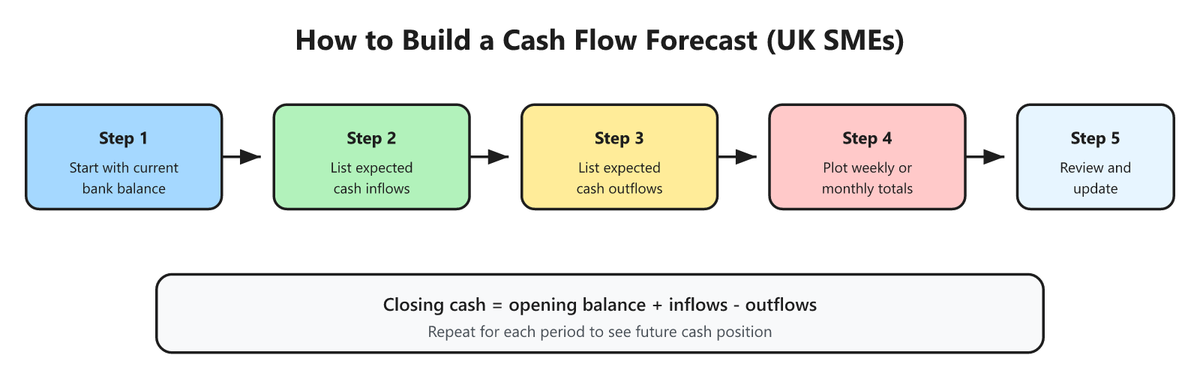
Step 1: Start with accurate current data
Pull your latest bank balances and a clear list of outstanding invoices and bills. If your bookkeeping is behind, fix that first. A forecast built on guesswork will not help.
Step 2: List expected inflows by date
Work from your sales pipeline, recurring contracts, and known payment patterns. Adjust for late payers if that is normal in your business.
Step 3: List expected outflows by date
Map fixed costs to their due dates. Spread variable costs based on recent history. Add tax payments on their expected schedule.
Step 4: Calculate closing cash for each period
For each week or month:
Closing cash = opening balance + inflows - outflows
Carry the closing balance forward as the next period's opening balance.
Step 5: Review and update regularly
A forecast is only useful if you revisit it. Compare actual cash movements to your forecast, note variances, and adjust assumptions. Many businesses update weekly for the short term and monthly for longer horizons.
How Often Should You Update Your Forecast?
Business situation | Suggested update frequency |
Stable cash position, few surprises | Monthly review, with a rolling 3 to 6 month view |
Tight cash or seasonal trading | Weekly review of the next 13 weeks |
Rapid growth or new funding | Weekly or fortnightly until patterns stabilise |
Major one-off spend planned | Update immediately when dates or amounts change |
Treat the forecast as a living document. When a big invoice is delayed or a cost increases, update the model the same day if possible.
Common Cash Flow Forecasting Mistakes
Forecasting on invoice dates instead of payment dates
Customers rarely pay the moment you invoice. Build in your real average collection period.
Forgetting tax and VAT
Tax payments are often the largest single outflow in a month. Use GOV.UK VAT guidance and your accountant's schedule to place them correctly.
Assuming every sale month is a cash month
Strong revenue in March may mean cash in April or May. Match receipts to behaviour, not optimism.
Ignoring small recurring costs
Software subscriptions, insurance instalments, and mileage claims add up. Missing them erodes trust in the forecast.
Building it once and never revisiting
A forecast from January will not reflect June reality. Schedule a regular review like any other management habit.
Cash Flow Forecasting vs Budgeting
These terms overlap but serve slightly different purposes.
Budgeting usually sets target income and spending for a financial year. It answers: "What do we plan to earn and spend?"
Cash flow forecasting answers: "When will money move, and will the bank balance stay positive?"
A budget can feed into your forecast, but the forecast must reflect payment timing. Many UK SMEs benefit from both: an annual budget for strategy and a rolling cash forecast for day-to-day control.
Tools and Support for UK SMEs
You can build a forecast in a spreadsheet, in cloud accounting software, or with support from your accountant. The right choice depends on complexity, your time, and how often you need scenario planning.
Spreadsheets work well for simple businesses with few moving parts. Accounting software can link to bank feeds and invoicing, which speeds up updates. If you employ staff, trade on credit terms, or pay VAT, professional support often pays for itself by catching timing issues early.
AMS Admin Services includes cashflow management, budgeting, and forecasting as part of our accounting and financial management services. We help UK SMEs turn bookkeeping data into clear forward-looking cash views alongside management reporting, so owners can make decisions with confidence.
When to Get Professional Help
Consider support from a qualified accountant if:
- you are unsure when tax and VAT payments will fall due
- you are planning hiring, new premises, or major equipment spend
- your bank balance is often within a few weeks of zero
- you are seeking finance and need credible projections
- you want to link cash forecasting to regular management accounts
Early visibility is cheaper than emergency borrowing or missed payments.
Frequently Asked Questions
What is cash flow forecasting in simple terms?
It is a plan that estimates how much cash your business will receive and pay out over future weeks or months, and what your bank balance is likely to be at each point.
How far ahead should a small business forecast cash flow?
Many UK SMEs use a 13-week rolling forecast for operations and extend to 6 or 12 months for tax and strategic planning. The right horizon depends on how quickly your cash position can change.
Is a cash flow forecast the same as a profit and loss forecast?
No. Profit forecasts focus on income and expenses, often when they are earned or incurred. Cash flow forecasts focus on when money is actually received or paid.
Do sole traders need a cash flow forecast?
Yes, if you want to plan for tax payments, quiet periods, or growth. Sole traders on cash basis accounting still face timing gaps between customer payments and personal or tax outgoings.
What is the best cash flow forecast template for a UK small business?
A simple template with opening balance, inflows, outflows, and closing balance by week or month is enough to start. Accuracy matters more than format.
Can my accountant prepare a cash flow forecast?
Yes. Many accountants and bookkeepers prepare forecasts as part of management reporting or advisory work. Ask what assumptions they use and how often they will update the model with you.
How does AMS help with cash flow forecasting?
AMS supports UK SMEs with bookkeeping, management accounts, budgeting, and cashflow management through our accounting and financial management service. Contact us for a free consultation.
Final Thoughts
Cash flow forecasting is one of the most practical tools a UK small business owner can use. It does not require complex software to start. It does require honest assumptions about when money arrives and leaves, and the discipline to update your view as circumstances change.
If you want help turning your numbers into a clear forward-looking cash plan, AMS Admin Services can support you with bookkeeping, management reporting, and cashflow management. Book a free consultation and see how clearer cash visibility can reduce stress and support growth.