Blog
When to Hire a Financial Controller: 5 Red Flags for Growing UK Businesses
Magnolia Roy | 30 July 2026
Five red flags that show a growing UK business may need a financial controller, plus how the role differs from accountant, CFO, and outsourced finance support.

When to Hire a Financial Controller: 5 Red Flags for Growing UK Businesses
Growth is good until the numbers stop keeping up. Invoices pile up. Month-end takes longer every quarter. The founder still approves every payment because nobody else trusts the figures. A lender asks for management accounts that are three months out of date.
That is when UK owners start searching for a financial controller and wondering whether they have waited too long.
A financial controller is not the same as your year-end accountant or a virtual CFO. They sit in the middle: responsible for accurate reporting, disciplined processes, and reliable month-end finance operations so leadership can make decisions with confidence.
This guide explains what a financial controller does, how the role differs from other finance support, and five red flags that suggest a growing UK business should hire one (or access equivalent outsourced support).
What Is a Financial Controller?
A financial controller (often called an FC) is a senior finance professional who oversees the accuracy and timeliness of a company's financial reporting and control environment.
Typical financial controller responsibilities include:
- month-end and management accounts close
- oversight of bookkeeping and reconciliations
- financial reporting for directors and stakeholders
- cash flow monitoring and working capital discipline
- finance process design and internal controls
- coordination with accountants, auditors, and tax advisers
- support for budgeting, forecasting, and KPI tracking
In larger businesses, a financial controller may manage a finance team. In growing UK SMEs, the role is often one experienced person who brings order to expanding complexity.
Good financial control turns raw transactions into trusted numbers leadership can act on.
Financial Controller vs Accountant vs CFO vs Bookkeeper
Role | Main focus | Typical timing |
Bookkeeper | Day-to-day transaction recording | Weekly or monthly |
Accountant | Compliance, tax, statutory accounts | Monthly to annual |
Financial controller | Reporting accuracy, month-end close, controls | Monthly (core rhythm) |
CFO / virtual CFO | Strategy, funding, board-level decisions | Monthly to quarterly |
A bookkeeper keeps records current. An accountant handles compliance and tax. A financial controller makes sure monthly reporting is reliable and processes hold up as you grow. A CFO focuses more on strategy and major decisions.
Many UK SMEs need a stronger controller layer before they need a full CFO. See our guide on virtual CFO vs outsourced finance admin for how these roles compare at the strategic end.
5 Red Flags: When to Hire a Financial Controller
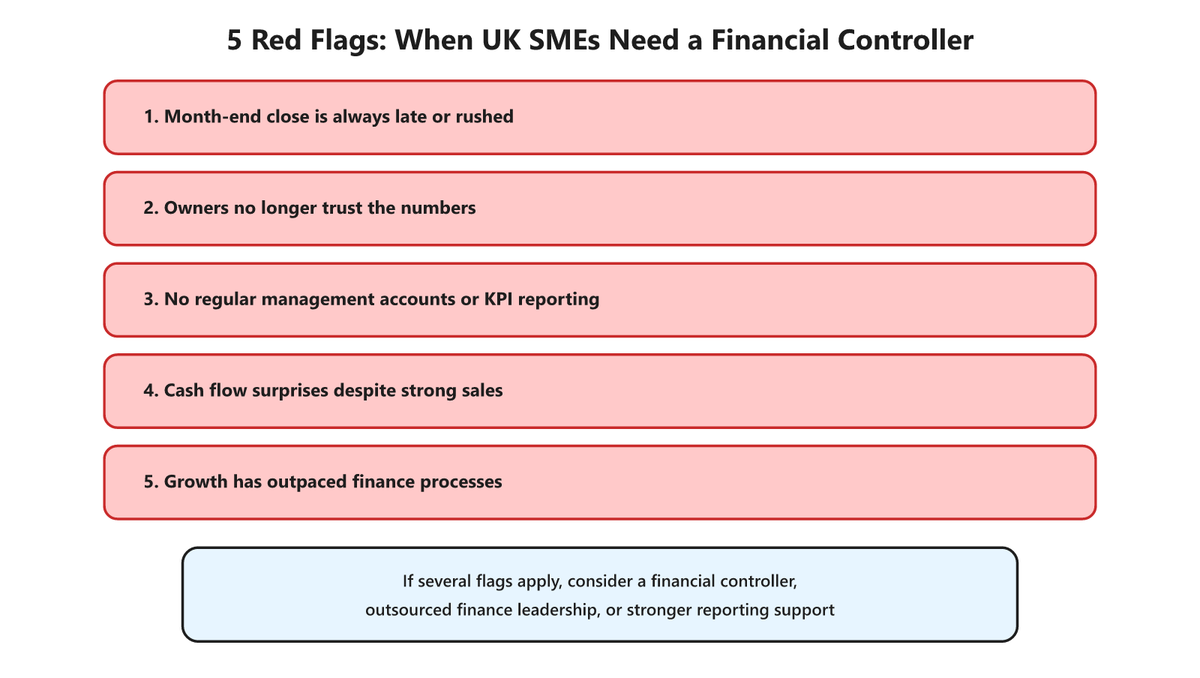
Red flag 1: Month-end close is always late or rushed
If closing the books takes longer each month, or only happens when a deadline forces it, reporting discipline is slipping.
A financial controller establishes a repeatable month-end process: reconciliations, review checkpoints, and clear deadlines. Without that, management accounts for UK SMEs arrive too late to guide decisions.
Red flag 2: Owners no longer trust the numbers
When directors routinely ask "are these figures right?" or rebuild reports in spreadsheets, the finance function has a credibility problem.
A financial controller improves accuracy through review, consistency, and clear reporting standards. Trust in numbers is not a luxury at growth stage. It is the foundation for hiring, pricing, and investment choices.
Red flag 3: No regular management accounts or KPI reporting
Year-end statutory accounts look backward. Growing businesses need forward visibility.
If you do not receive regular management accounts, cash summaries, or KPI dashboards, you are flying partly blind. GOV.UK guidance on annual accounts covers statutory reporting requirements, but management insight is a separate operational need.
A financial controller ensures monthly or quarterly reporting happens reliably, not only at year-end.
Red flag 4: Cash flow surprises despite strong sales
Revenue can grow while cash tightens. Late customer payments, VAT timing, payroll cycles, and stock investment all affect liquidity.
If cash stress keeps appearing without warning, you need stronger monitoring and cash flow forecasting UK, not just a P&L review.
Financial controllers focus on working capital, payment discipline, and cash visibility alongside profit reporting.
Red flag 5: Growth has outpaced finance processes
Common growth triggers include:
- more employees and payroll complexity
- VAT registration or higher turnover bands
- multiple revenue lines or locations
- higher supplier volumes and approval bottlenecks
- board, investor, or lender reporting requirements
As finance processes scale, controls over supplier bank detail changes, payment approvals, expense claims, and accounting software access become more important.
When headcount, transactions, and approvals scale faster than finance processes, errors and delays multiply. That is a classic point to bring in a financial controller or outsourced equivalent.
Red flag | What it usually means | Risk if ignored |
Late month-end close | Weak process discipline | Late decisions, compliance pressure |
Numbers not trusted | Accuracy or consistency gaps | Bad strategic calls |
No management reporting | Reactive management | Missed warnings |
Cash surprises | Weak cash visibility | Payroll or tax pressure |
Growth outpaced finance | Processes not scaled | Errors, fraud risk, burnout |
Full-Time Financial Controller vs Outsourced Support
Not every UK SME needs a full-time hire on day one.
Option | Best when | Considerations |
Full-time financial controller | Daily oversight needed, larger team, complex operations | Salary, benefits, management time |
Part-time / outsourced FC | Growing SME needs senior control without full headcount | Scope, access, integration with accountant |
Strong outsourced finance admin + accountant | Reporting gaps but not yet FC-level complexity | May be enough before full FC hire |
GOV.UK sets separate deadlines for limited company accounts and Company Tax Returns. A financial controller helps keep records, reconciliations, and management reporting up to date throughout the year, so statutory accounts and tax work are less likely to become a last-minute scramble.
Financial Controller vs Outsourced Finance Admin
Outsourced finance admin is often enough when the main problems are bookkeeping delays, inconsistent reporting, VAT coordination, invoicing, or cash flow visibility.
A financial controller becomes more relevant when the business needs stronger month-end ownership, review controls, reporting discipline, board-ready management accounts, and oversight of a growing finance process.
For many SMEs, the right first step is not a full-time FC hire. It is a structured upgrade to bookkeeping vs accounting, management accounts, cash flow reporting, and internal controls.
Compare options using the same lens as accountant prices UK and bookkeeping vs accounting: match the role to the work, not the job title alone.
What to Look for When Hiring a Financial Controller
Whether you hire in-house or use outsourced support, check:
- experience with UK SMEs at your turnover and complexity
- ability to produce timely management accounts
- strength in reconciliations, controls, and month-end close
- comfort with cloud accounting software
- coordination skills with your accountant and payroll provider
- plain-English communication with non-finance directors
Ask for examples of reporting they have produced and how they improved month-end timing in previous roles.
How AMS Admin Services Supports Growing UK Businesses
AMS Admin Services helps UK SMEs build the finance foundation many businesses need before or instead of a full-time financial controller hire.
Through our accounting and financial management services from £349/mo, we support:
- bookkeeping and VAT
- management account preparation
- cashflow management and budgeting
- KPI reporting
- cloud accounting setup and ongoing reporting
That gives growing businesses clearer monthly numbers, stronger processes, and less reliance on the founder as the default finance lead.
Where deeper finance leadership is required, we help you understand whether you need stronger reporting support, virtual CFO vs outsourced finance admin, or fractional CFO-style input. We do not oversell a full financial controller hire when your immediate need is cleaner records and reliable management reporting.
Book a free consultation and we will recommend support matched to your stage.
Common Mistakes When Considering a Financial Controller
Hiring an FC before fixing basic bookkeeping
A controller cannot build strategy on unreliable data. Stabilise records first.
Expecting an FC to replace your external accountant
Compliance and tax filing often remain with your accountant. The FC improves internal reporting and control.
Confusing FC with CFO
If the main need is funding strategy or board-level planning, you may need virtual CFO vs outsourced finance admin support instead. If the need is month-end discipline and reporting accuracy, an FC fits better.
No clear scope or reporting calendar
Define monthly deliverables, meeting rhythm, and who approves payments before hiring.
Ignoring payroll and VAT integration
Finance control works best when payroll, VAT, and accounts are aligned. See our UK payroll cost guide if hiring is part of your growth plan.
How Much Does a Financial Controller Cost in the UK?
Costs vary depending on whether the role is full-time, part-time, or outsourced. A full-time financial controller usually involves salary, employer National Insurance, pension contributions, recruitment costs, software access, and management time.
Part-time or outsourced support is usually priced by scope, reporting frequency, complexity, and seniority. Compare providers by monthly deliverables: management accounts, reconciliations, reporting packs, cash flow reviews, controls, and coordination with your accountant.
Frequently Asked Questions
What does a financial controller do in a UK SME?
A financial controller oversees month-end close, management reporting, reconciliations, finance processes, and cash monitoring so directors receive accurate, timely numbers.
When should a growing UK business hire a financial controller?
Consider hiring when month-end is consistently late, leaders do not trust reports, management accounts are missing, cash keeps surprising you, or growth has outpaced finance processes.
What is the difference between a financial controller and a CFO?
A financial controller focuses on reporting accuracy, controls, and month-end operations. A CFO focuses more on strategy, funding, and high-level business decisions.
Do I need a financial controller or an accountant?
Most SMEs need an accountant for compliance and tax. A financial controller adds monthly control and reporting discipline. Larger or faster-growing businesses often need both.
Can I outsource a financial controller role?
Yes. Many UK SMEs use part-time or outsourced finance leaders to get controller-level oversight without a full-time salary.
How much does a financial controller cost in the UK?
Costs vary by experience, hours, sector, and whether the role is employed or outsourced. Compare scope and deliverables rather than title alone. AMS provides personalised quotes after a free consultation.
How does AMS help if I am not ready for a full financial controller?
AMS provides management accounts, cashflow support, KPI reporting, and bookkeeping through our accounting and financial management services, building the foundation many businesses need first.
What is the first step if several red flags apply?
Review your current month-end process, latest management accounts, and cash visibility. Contact AMS for a free consultation to identify the right level of support.
Disclaimer
This article is for general information only. It is not tax, legal, or financial advice. HMRC rules, GOV.UK guidance, and filing requirements can change. Speak to a qualified accountant or adviser for advice tailored to your business.
Final Thoughts
When to hire a financial controller is not about company size alone. It is about whether your finance function can keep pace with how you operate today.
If month-end is late, numbers are questioned, reporting is thin, cash keeps surprising you, or growth has strained your processes, the five red flags above are telling you something important: you need stronger financial control.
That may mean a full-time financial controller, part-time outsourced support, or a structured upgrade to management reporting and finance processes. The right answer depends on your complexity, not your ambition alone.
If you want clearer monthly reporting and practical finance support without jumping straight to a full-time hire, AMS Admin Services can help. Book a free consultation and find out what level of support fits your business today.