Blog
Year-End Tax Planning Tips for UK Small Business Owners (2025 Edition)
Yashi Shrivastav | 28 November 2025
Year-end Tax Planning can meaningfully reduce your 2025–26 tax bill if you act early. From using full expensing and AIA, to tightening VAT compliance, maximising the dividend and CGT allowances, and preparing for Making Tax Digital, these steps help UK small business owners cut tax, protect cash flow, and enter 2026 with clarity and confidence.

How to close the year strong and get ready for 2026 with confidence.
As the year end is coming closer, many UK business owners are reviewing their numbers, catching up on paperwork, and tax planning for the months ahead.
These last few weeks of 2025 are a valuable window to make smart financial decisions that can strengthen your cash flow and reduce your tax bill before deadlines hit.
With 2026 just around the corner, there are two key dates to keep in mind:
31st December 2025: the calendar year-end for many companies.
5th April 2026: the personal tax year-end for individuals and directors.
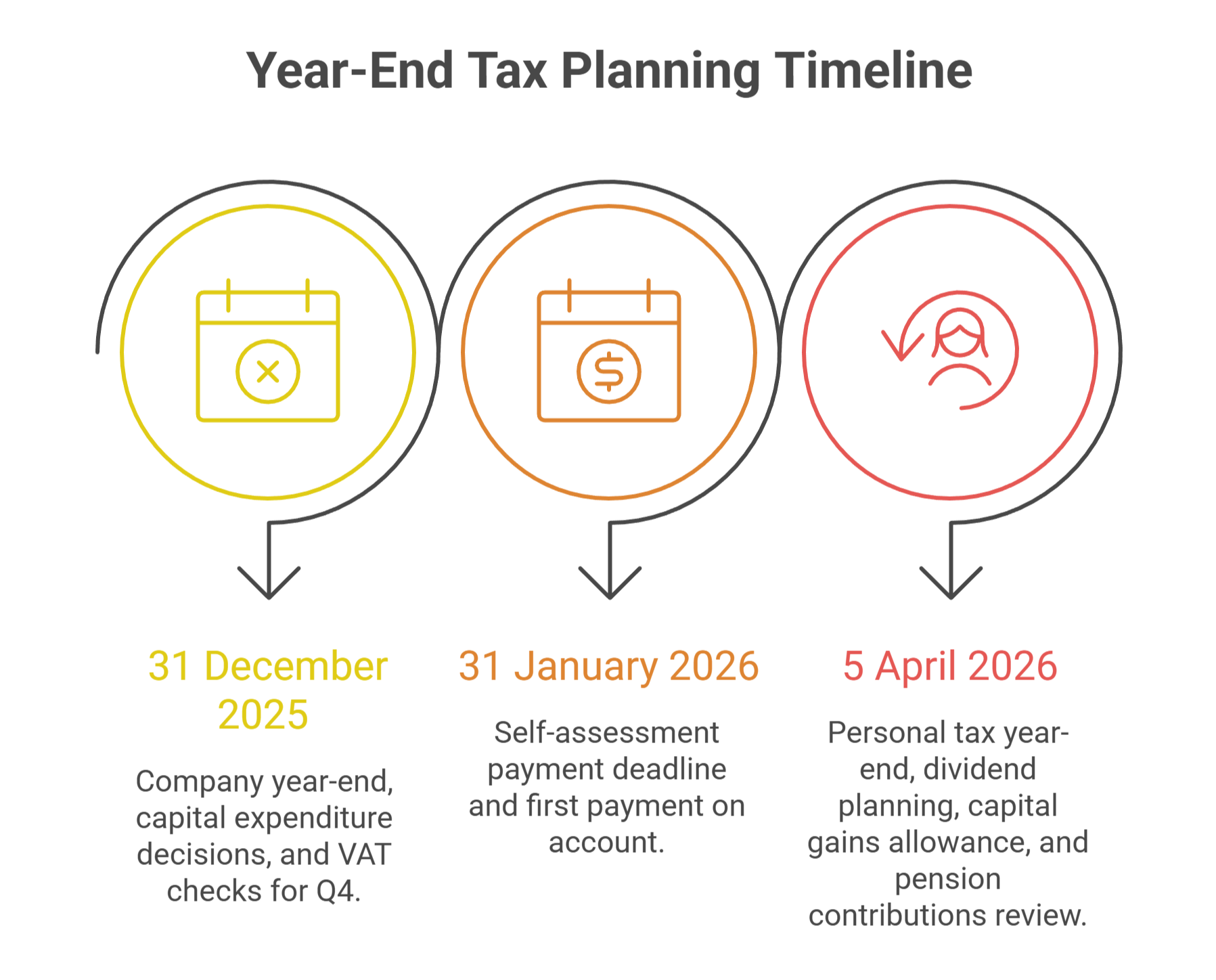
Both bring opportunities to fine-tune your finances, optimize allowances, and get ready for the upcoming Making Tax Digital for Income Tax changes from 6 April 2026, which will require digital records and quarterly submissions.
This guide walks you through the essential year-end actions to complete before those dates, practical, compliant, and designed to help you start 2026 with clarity and confidence.
1. Make the Most of Capital Investment Reliefs (Before 31 December 2025)
Full expensing now applies permanently to companies investing in new and unused main-rate plant and machinery, offering 100% relief in the year of purchase. Most cars and assets for leasing are excluded.
For other expenses, including second-hand assets, special-rate items, and for unincorporated businesses, the Annual Investment Allowance (AIA) gives 100% relief up to £1 million on most plant and machinery (cars excluded). The £1 million limit is permanent and available to most businesses, including companies.
AMS Tip: Full expensing is now permanent, so there’s no need to rush - but aligning purchases with cash flow and profit forecasts can still help manage your tax position and liquidity.
2. Keep VAT Compliance Clean Going Into 2026
Year-end is the perfect time for a quick VAT hygiene check.
- Confirm your next VAT return and payment due dates - usually one month and seven days after your VAT period ends for standard schemes.
- Ensure your Direct Debit mandates align with your accounting software.
- Monitor turnover against the £90,000 registration threshold (or £88,000 deregistration limit).
- Review old invoices: if any remain unpaid for 6 months after the later of the due date and the date of supply, and are written off to a bad-debt account, you can reclaim the VAT element in Box 4 when the conditions are met.
AMS Tip: Use cloud accounting tools to track overdue invoices and automate VAT reminders - it keeps you compliant and improves cash flow visibility.
3. Optimise Dividends Before 5 April 2026
The dividend allowance for 2025/26 remains £500, so tax planning is essential.
- Review your profit position and dividend timing before 5 April.
- Where possible, spread distributions between spouses or partners to use both allowances.
- Revisit your salary and dividend mix to ensure efficiency and compliance with HMRC guidance.
- Dividend tax rates depend on your income band - review your overall income position before declaring year-end dividends.
AMS Tip: A short review with your accountant can reveal easy savings - the timing of a single dividend payment can shift how much tax you pay
.
4. Use Your Capital Gains Allowance Wisely
The Capital Gains Tax Annual Exempt Amount is still £3,000 per person for 2025/26 and cannot be carried forward.
- If you’re holding assets with modest gains, consider selling before 5 April to make full use of this allowance.
- Spouse transfers are “no gain/no loss” while living together, allowing you to double up on relief.
AMS Tip: Timing disposals either side of the tax year can make a real difference - especially if your income varies year to year.
5. Check Your Basis Period and Payments on Account (Sole Traders & Partners)
From 2024/25 onwards, all unincorporated businesses are taxed on profits for the tax year (with accounting dates between 31 March and 5 April treated as 5 April) under the new tax-year basis.
- Review payments on account due 31 January 2026 and 31 July 2026.
- If profits are expected to fall, submit a claim to reduce to avoid overpaying - but note that interest may apply if you reduce too far.
AMS Tip: Use real-time bookkeeping data to project your taxable profit. It helps you justify any reduction and avoid cash-flow surprises later.
6. Get Ready for Making Tax Digital for Income Tax (MTD ITSA)
From 6 April 2026, Making Tax Digital for Income Tax became mandatory for individuals with more than £50,000 of combined self-employment and property income (gross).
You’ll need to:
- Keep digital records of all income and expenses.
- Submit quarterly updates to HMRC.
- Complete a year-end digital finalisation to confirm figures.
Start preparing now:
- Choose MTD-compatible software and test it early.
- Set up quarterly-update workflows; the first update for 6 Apr-5 Jul 2026 will fall in early August 2026.
- Review your bookkeeping routine so every transaction is captured digitally.
AMS Tip: Preparing early reduces stress later. AMS can support you with software setup, data migration, and digital filing routines.
7. Corporation Tax Positioning: Plan for Profit Bands
Corporation tax rates remain:
- 19% on profits up to £50,000
- 25% on profits over £250,000
- Marginal relief in between
If you have associated companies, these thresholds are divided between them, which can move you into the higher rate sooner.
AMS Tip: Align capital spending and bonuses with cash flow and growth plans. Employer pension contributions are usually deductible when paid, provided they’re wholly and exclusively for the business - though very large one-off contributions can sometimes be spread over multiple periods.
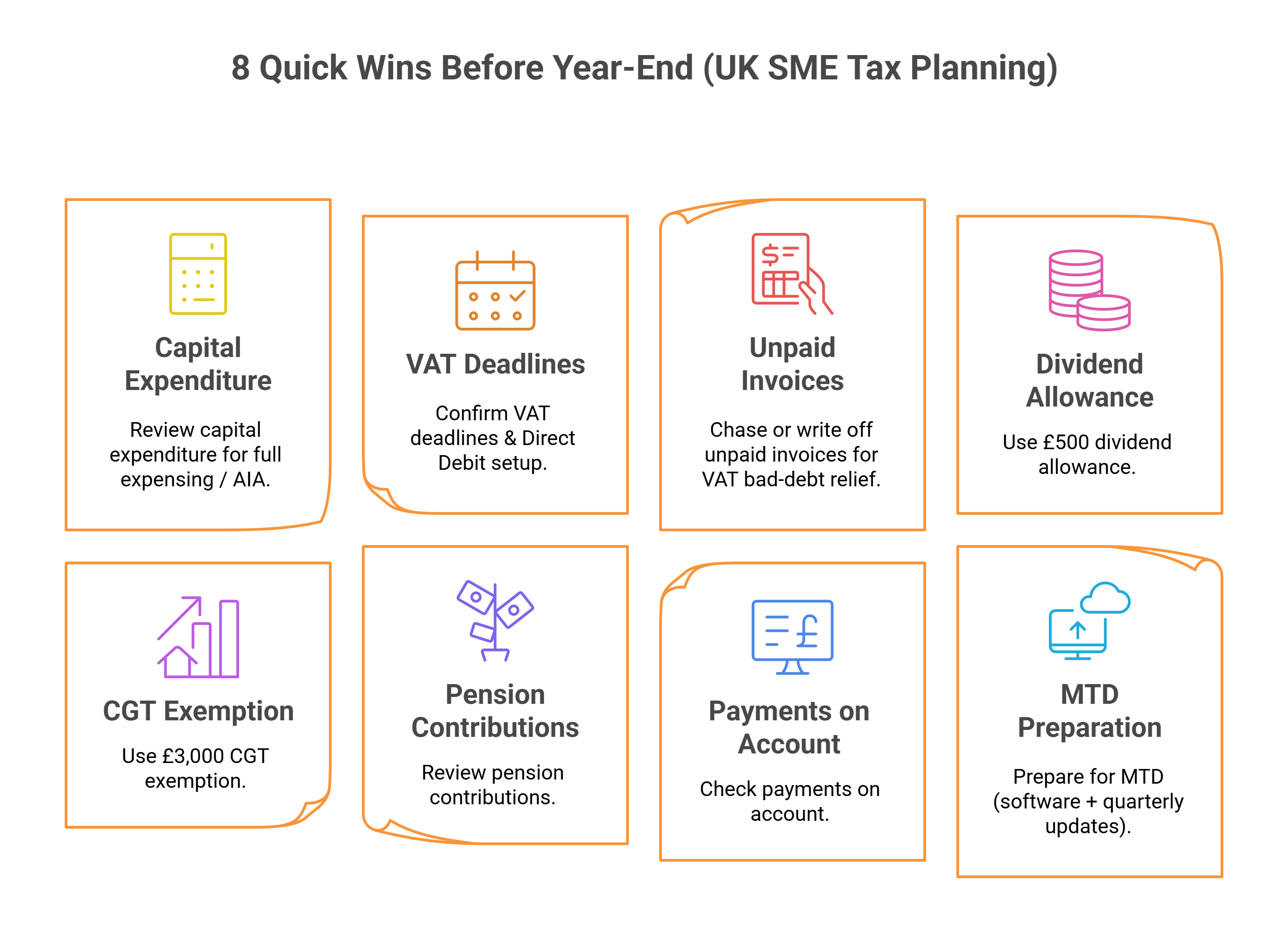
8. Quick Wins to Lock In Before Year-End
By 31 December 2025:
- ✅ Review capital expenditure for full expensing or AIA eligibility.
- ✅ Confirm VAT deadlines and Direct Debit alignment.
- ✅ Chase or write off old debts to reclaim VAT where eligible.
By 5 April 2026:
- ✅ Use the £500 dividend allowance and £3,000 capital-gains exemption.
- ✅Review pension contributions and spouse dividend splits (for individuals, tax planning runs to 5 April).
- ✅ Check payments on account and adjust if needed.
- ✅ Prepare MTD-compatible systems if within the 2026 rollout.
Extra checkpoints:
- Consider employer pension contributions before your accounting period end - usually deductible when paid, unless the amount is unusually large.
- If claiming R&D for a period starting on or after 1 April 2023, check if pre-notification applies - typically required if you’re a first-time claimant or haven’t claimed in the last three years and you’ll file more than six months after the period end.
- Review Time to Pay or Budget Payment Plans to smooth January liabilities.
Frequently Asked Questions
Q: What year-end tax planning steps should UK small business owners take?
Review capital investment for full expensing or AIA, tidy VAT compliance, plan dividends before 5 April, use the £3,000 CGT allowance, and check payments on account. These steps can reduce your 2025–26 tax bill and improve cash flow.
Q: What’s the difference between full expensing and the Annual Investment Allowance?
Full expensing gives companies 100% relief on qualifying new main-rate plant and machinery. AIA gives 100% relief on most plant and machinery (excluding cars) up to £1 million, and applies to most businesses, including those buying second-hand assets.
Q: How can small businesses prepare for Making Tax Digital for Income Tax?
Move to MTD-compatible software, keep digital records, and set up workflows for quarterly updates before April 2026. Preparing early makes compliance easier.
9. The AMS Way: Simplicity Meets Strategy
At AMS Admin Services, we believe year-end should bring clarity. Our team helps you plan, project, and prepare - turning compliance into confidence.
From full-expensing guidance to digital-record migration for MTD, we deliver:
- Clear advice you can trust
- Transparent pricing with no hidden costs
- Consistent support built for UK SMEs and founders
Takeaway
As the year end approaches, every decision counts. A few proactive steps now can reduce your tax burden, strengthen your position for 2026, and set you up for a smooth transition into Making Tax Digital.
Ready to simplify your year-end?